

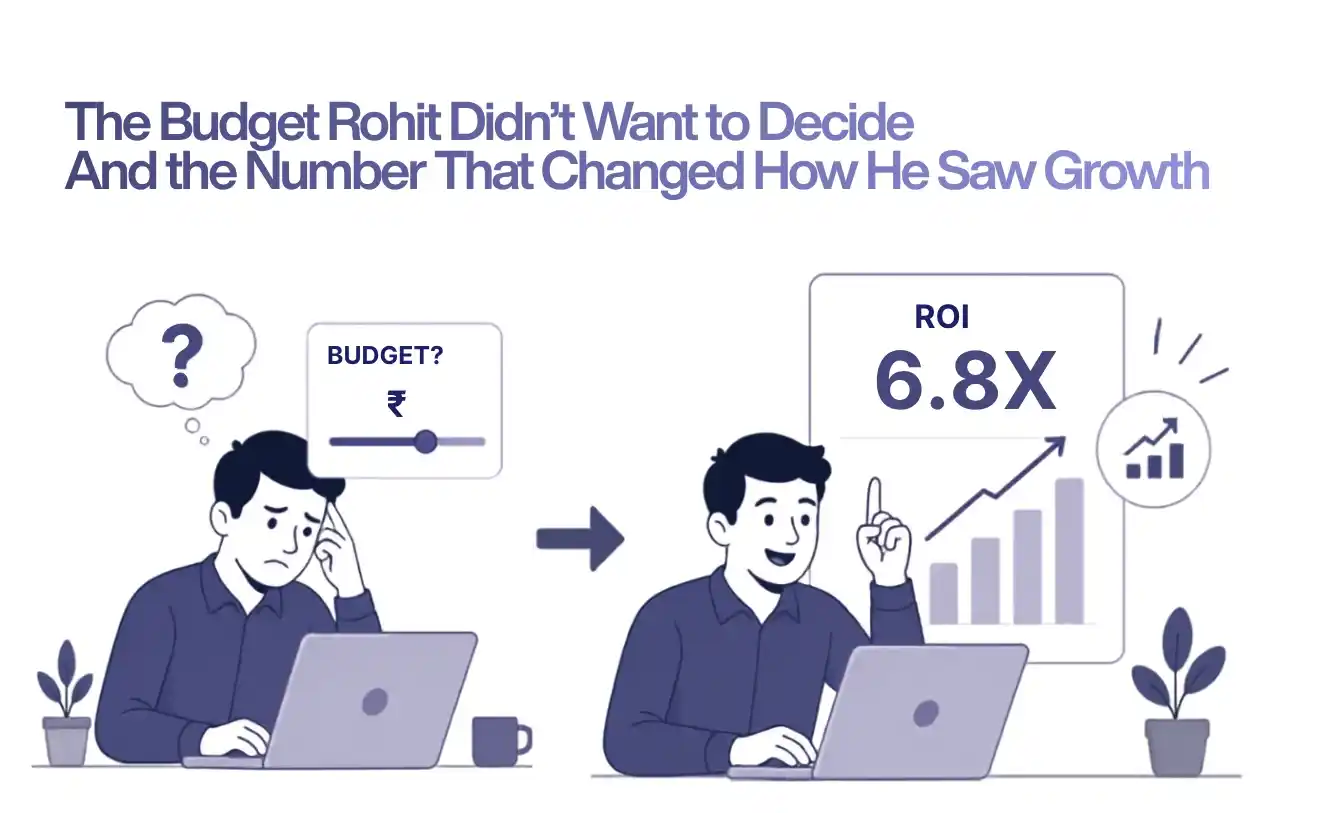
The Budget Rohit Didn’t Want to Decide
And the Number That Changed How He Saw Growth
Spending too little keeps you invisible. Spending blindly drains you. Somewhere in between is the point where growth actually begins.
Rohit sat at his dining table in Bengaluru, staring at a blank Excel sheet.
Column one: “Expenses.”
Column two: “Marketing.”
He sighed.
His online furniture store had just completed three months. Orders were coming in, but slowly. Friends kept repeating the same advice.
“Invest in digital marketing.”
But how much?
₹10,000? ₹50,000? ₹1 lakh?
He opened Google. Too many answers. Too many opinions. Every article seemed to promise growth, but none explained what a realistic digital marketing budget India businesses actually needed in 2026.
His phone buzzed.
A competitor’s Instagram ad appeared on the screen. Clean visuals. Sharp messaging. Professional product videos.
Rohit clicked. Scrolled. Then quietly closed the app.
Back to the Excel sheet.
Because the real question wasn’t how to do marketing.
It was how much to risk on it.
And that decision felt heavier than anything else.
For many small businesses in India, this is the hardest part of digital marketing. Not content creation or ads. Nor SEO.
The budget.
Because budgeting is emotional before it becomes mathematical.
Every rupee feels personal when you’re building something from scratch.
And yet, one thing becomes clear very quickly in business:
Visibility costs money. Invisibility costs even more.
Why Digital Marketing Budgeting Feels So Confusing in India
Rohit wanted a simple answer.
A fixed number. A safe range. Something predictable.
But digital marketing doesn’t work like buying office furniture or paying electricity bills. There is no universal “correct” amount.
Your digital marketing budget in India depends on your business stage, goals, competition, and how fast you want growth to happen.
That’s why two businesses in the same city can spend completely different amounts and still make smart decisions.
Most businesses in India usually allocate around 5% to 15% of their revenue toward marketing.
But the percentage changes depending on where the business stands.
New Businesses Usually Spend More
If you are just starting, your marketing budget percentage is often higher.
Usually around 10% to 12% of revenue.
Why?
Because you are not only trying to sell.
You are trying to become visible.
People don’t know your brand yet. Google doesn’t trust your website yet. Social media algorithms haven’t learned your audience yet.
You are building awareness from zero.
That requires more effort, more testing, and more consistency.
Established Businesses Spend Differently
Older businesses often spend closer to 5% to 8%.
Not because marketing matters less.
But because they already have:
- Brand recognition
- Returning customers
- Existing search visibility
- Customer referrals
- Better conversion rates
At that stage, marketing becomes optimisation rather than introduction.
And suddenly, Rohit understood something important.
The budget wasn’t random.
It reflected the stage of the business.
A Realistic Digital Marketing Budget India Businesses Follow
Many small and mid-sized businesses in India usually fall into these ranges:
| Business Stage | Typical Monthly Budget |
|---|---|
| Small local businesses | ₹20,000 – ₹50,000 |
| Growing startups | ₹50,000 – ₹1,50,000 |
| Competitive ecommerce brands | ₹1.5 lakh+ |
But numbers alone don’t tell the full story.
A ₹30,000 budget used intelligently can outperform a poorly planned ₹1 lakh campaign.
Because digital marketing is not just spending.
It’s allocation.
And this is where most businesses start making mistakes.
Where Your Digital Marketing Budget Actually Goes
At first, Rohit assumed marketing simply meant running ads.
Put money into Google Ads or Instagram promotions. Get customers out.
Simple.
But after speaking with a consultant, the breakdown surprised him.
The budget wasn’t going into one thing.
It was being divided into systems.
Paid Ads
This is the fastest-moving part of digital marketing.
Google Ads, Meta Ads, YouTube promotions, retargeting campaigns.
Ads help businesses generate traffic quickly.
But traffic alone doesn’t guarantee sales.
Content Creation
This included:
- Product photography
- Short-form videos
- Reels
- Blog content
- Social media creatives
- Brand storytelling
Content builds trust before people buy.
Without strong content, even expensive ads struggle to convert.
SEO and Website Visibility
SEO often feels invisible in the beginning.
But over time, it becomes one of the strongest long-term growth channels.
For Rohit’s furniture business, SEO meant appearing when someone searched:
- “modern sofa designs India”
- “wooden dining table online”
- “best furniture store Bengaluru”
A smart digital marketing budget India businesses use in 2026 usually includes SEO because paid ads stop the moment spending stops.
SEO keeps working longer.
Tools and Tracking
Then came the part Rohit never considered.
Analytics.
Tracking.
Website improvements.
CRM tools.
WhatsApp automation.
Conversion optimisation.
These don’t look exciting from the outside, but they decide whether traffic becomes revenue.
This is where many businesses fail.
They spend everything on visibility but nothing on conversion.
And visibility without conversion becomes expensive noise.
Why Spending Everything on Ads Usually Fails
Rohit remembered something his consultant said.
“Ads amplify what already exists.”
If the landing page is confusing, ads send more people into confusion.
Product photos look weak, ads amplify weak trust.
If follow-ups are slow, ads simply bring more missed opportunities.
This is why a balanced digital marketing budget matters more than a large one.
In India, many growing businesses roughly distribute their budget like this:
- 35%–45% on ads
- 20%–30% on content
- 15%–25% on SEO
- 10%–15% on tools, analytics, and optimisation
The exact percentages vary, but the principle stays the same:
Growth comes from connected systems.
Not isolated spending.
What Happens When You Underbudget Marketing
Rohit decided to “test” marketing first.
₹10,000 for ads.
A few boosted Instagram posts. Some clicks. A couple of inquiries.
Then silence.
So he stopped everything.
This happens constantly with Indian businesses.
The budget becomes inconsistent.
One week ads run. The next week they pause. Then restart during festivals. Then disappear again.
And digital marketing struggles in inconsistency.
Because platforms need time to learn.
Campaigns need time to optimise.
Audiences need repeated exposure before trust forms.
Most businesses see meaningful digital marketing results over three to six months, not three to six days.
But underbudgeting creates the illusion that marketing doesn’t work.
When the truth is:
It was never given enough time or structure to work properly.
Overspending Without Strategy Creates a Different Problem
The opposite mistake is equally dangerous.
Some businesses overspend aggressively without direction.
₹1 lakh. ₹2 lakh. Massive influencer campaigns. Constant ad boosts.
But no strategy underneath.
No funnel.
Nor tracking.
No audience clarity.
Neither understanding of what is actually converting.
Rohit had seen this happen to a friend running a café.
Big promotions.
High engagement.
Thousands of views.
But inconsistent footfall.
Because likes are not revenue.
Visibility is not automatically growth.
And marketing without structure becomes expensive performance theatre.
A bigger digital marketing budget India businesses spend does not guarantee success.
A smarter one does.
The Moment the Excel Sheet Started Making Sense
That night, Rohit reopened the spreadsheet.
But something felt different this time.
Less fear.
More clarity.
He calculated his monthly revenue.
Then chose a realistic percentage.
Not too small to disappear.
Not too large to create panic.
Then he divided it carefully.
Ads.
Content.
Tracking.
Customer follow-up.
Simple.
Clear.
For the first time, digital marketing no longer felt like gambling.
It felt like planning.
And that shift changed everything.
Because once you stop treating marketing like random spending, you begin treating it like business infrastructure.
Something designed to create predictable growth over time.
How to Build a Smarter Digital Marketing Budget in India for 2026
If you are planning your digital marketing budget India strategy for 2026, start with these questions:
What Stage Is My Business In?
A new business needs visibility.
An established business may need optimisation.
Your stage changes your spending priorities.
What Is My Actual Goal?
More leads?
More sales?
Better brand awareness?
Higher repeat purchases?
Your budget should follow your objective.
Can My Website Convert Traffic?
Before increasing ad spend, improve:
- Website speed
- Mobile experience
- Product pages
- Trust signals
- Customer reviews
- WhatsApp response systems
Because conversion matters more than traffic volume.
Am I Building Long-Term Visibility?
Paid ads bring speed.
SEO builds sustainability.
Strong businesses usually invest in both.
Growth Is Not About Spending More
Rohit finally understood something most businesses learn late.
Growth does not come from spending the most.
It comes from spending intentionally.
A realistic digital marketing budget India businesses need in 2026 is not about copying competitors or blindly increasing ad spend.
It’s about alignment.
Alignment between your business stage, your audience, your systems, and your long-term goals.
Because marketing works best when it stops feeling random.
And starts feeling structured.
So if you looked at your current marketing budget today, would it actually create growth?
Or is it only helping you “try” marketing and hope something works?
Reference
How Much Should Small Businesses Spend on Digital Marketing in India (2026 Budget Guide)