

The Day Ramesh Realised His Ads Were Lying
And What That Taught Him About Real Returns
Sometimes the numbers you celebrate are the same numbers quietly costing you money.
That’s one of the biggest lessons businesses learn while understanding digital marketing ROI in India.
Ramesh stood behind the counter of his electronics shop in Vijayawada, watching a customer scroll through his phone.
“Sir, I saw your ad on Instagram,” the young man said, showing him a post about discounted Bluetooth speakers.
Ramesh smiled immediately.
That ad had performed brilliantly.
Thousands of views.
Hundreds of likes.
Comments asking for prices kept appearing throughout the day.
For weeks, those numbers had made him feel confident about his marketing.
“Good, good,” he replied, reaching for the product from the shelf.
But then came the next question.
“Online it says ₹1,499. Can you do ₹1,200?”
Ramesh paused.
That wasn’t the price he wanted to sell at.
After a few minutes of negotiation, he agreed anyway.
The customer left happy.
But Ramesh didn’t feel the same satisfaction.
An hour later, he checked his phone again.
Another spike in engagement.
More likes.
More comments.
More reach.
But when he opened his cash drawer that evening, the numbers told a completely different story.
He had sold six speakers that day.
Yet his actual profit was painfully small.
That was the moment something finally clicked.
For the first time, Ramesh stopped asking whether his ads were popular.
Instead, he asked a much more important question:
What exactly are these ads giving me?
That question sits at the heart of digital marketing ROI in India today.
Because many businesses are running campaigns, boosting posts, and spending money online without truly understanding what those numbers mean.
And sometimes, digital marketing doesn’t fail loudly.
It fails while looking successful.
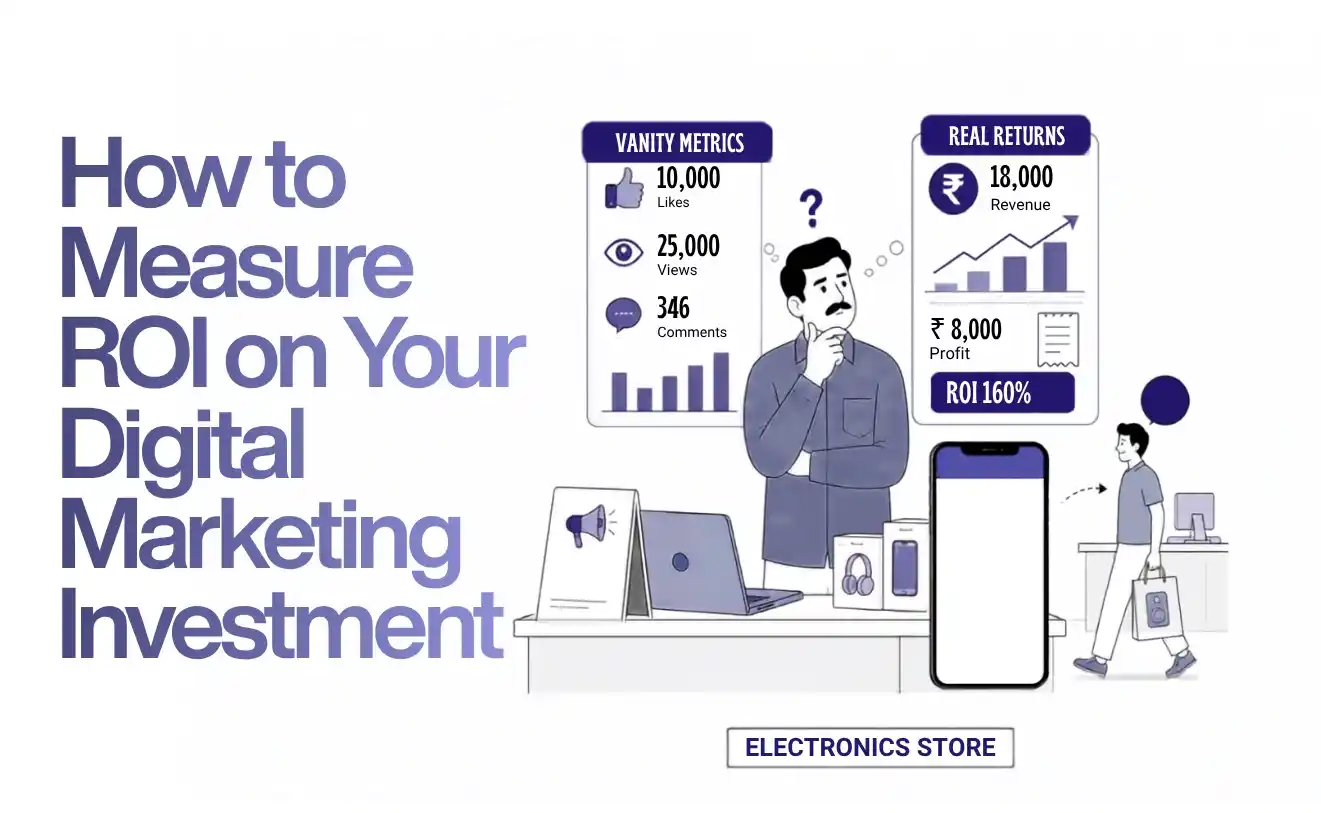
When “Good Numbers” Don’t Mean Good Business
Ramesh had been tracking what most businesses track first:
Likes.
Views.
Shares.
Comments.
Follower growth.
At first glance, these numbers feel exciting.
A post with 10,000 views feels like success.
A reel with hundreds of comments feels like momentum.
But visibility alone doesn’t always lead to revenue.
That’s where many businesses misunderstand digital marketing ROI in India.
They celebrate attention without measuring outcomes.
And attention without conversion can quietly drain money.
This is why marketers often call these vanity metrics.
They look impressive on the surface but don’t always connect to actual business growth.
Because at the end of the day, likes don’t pay rent.
Views don’t increase margins.
And shares don’t automatically create loyal customers.
Real business growth comes from something deeper.
It comes from understanding what happens after someone sees your content.
Do they click?
Do they message?
Do they visit your store?
Do they trust your business enough to buy?
That’s where ROI begins.
Understanding Digital Marketing ROI in Simple Terms
ROI stands for Return on Investment.
In simple language, it answers one question:
For every rupee you spend on marketing, how much are you getting back?
The formula itself is simple.
ROI=Money SpentMoney Earned−Money Spent
But real digital marketing ROI in India is often more layered than a basic formula.
Because digital marketing doesn’t always create instant purchases.
Sometimes an Instagram ad creates awareness.
Sometimes a Google search builds trust.
Sometimes a WhatsApp conversation leads to a sale weeks later.
Customer decisions rarely happen in one step anymore.
That’s what Ramesh slowly began to understand.
He wasn’t measuring customer behaviour.
He was only measuring noise.
And noise can become expensive very quickly.
Why Most Businesses Struggle to Measure ROI
One of the biggest challenges in digital marketing is that customers move across multiple platforms before buying.
Someone might discover your business through Instagram.
Later they search your business name on Google.
Then they check reviews.
Then they message you on WhatsApp.
And finally, days later, they make a purchase.
If you only measure the first click, you miss the entire customer journey.
That’s why businesses often misunderstand which marketing channels are actually working.
Ramesh had been boosting posts regularly without tracking what customers did afterward.
He assumed engagement meant growth.
But engagement without conversion is incomplete data.
That realization changed how he viewed marketing entirely.
Following the Customer Instead of the Click
A week later, Ramesh tried something different.
Instead of boosting every product post, he focused on one simple campaign.
A WhatsApp offer.
“Message us for today’s best price.”
That small change shifted his focus completely.
Now he wasn’t counting likes anymore.
He was counting conversations.
Each message became a lead.
Each lead became a possible customer.
For the first time, his marketing felt measurable.
This is called tracking the customer journey.
Understanding the path someone takes before buying.
For example:
- They discover your Instagram page
- They visit your Google Business Profile
- They check reviews
- They message you on WhatsApp
- They visit your shop
- Then they buy
That entire journey matters.
Because ROI lives inside that journey.
Not just inside ad impressions.
Ramesh started writing things down carefully.
How many people messaged.
How many visited his store.
How many purchased.
How many returned later.
Slowly, patterns started appearing.
His Instagram ads created awareness.
But his WhatsApp conversations closed sales.
That insight changed everything.
“The real return isn’t in the click. It’s in what the click becomes.”
Turning Data Into Better Decisions
Once Ramesh understood where customers were actually converting, he made a bold decision.
He reduced his ad spend by almost half.
Not because advertising didn’t work.
But because he finally knew which ads worked.
Earlier, he promoted everything.
Every product.
Every discount.
Every offer.
Now he became more selective.
He focused on high-margin products.
He scheduled campaigns around weekends when store visits increased.
He replied faster to WhatsApp enquiries.
He improved product descriptions.
He paid closer attention to customer questions.
This is what measuring digital marketing ROI in India really does.
It removes guesswork.
It helps businesses make smarter decisions instead of emotional ones.
And importantly, it prevents unnecessary spending.
You Don’t Need Complicated Tools to Start
For many small business owners, ROI tracking sounds technical.
Ramesh thought the same initially.
He assumed he needed expensive software or advanced analytics knowledge.
But the truth was much simpler.
You can begin with basic tracking.
A spreadsheet.
A notebook.
WhatsApp Business insights.
Google Business Profile.
Simple records of enquiries and sales.
The key is consistency.
If you spend ₹1,000 on ads, track what happens afterward.
Not just in terms of likes.
But in terms of leads.
Not just leads.
Actual sales.
Because sometimes a campaign that reaches fewer people creates far more profit.
And that matters more.
This is one of the most important lessons businesses learn while improving digital marketing ROI in India.
More visibility doesn’t always mean more revenue.
Smarter visibility does.
Building Trust Instead of Chasing Attention
A month later, the same customer walked into Ramesh’s shop again.
But this time, the conversation felt different.
“I messaged you on WhatsApp yesterday,” the customer said. “You suggested a better model.”
Ramesh immediately remembered him.
There was no bargaining this time.
No confusion.
The customer already trusted the recommendation.
The sale happened smoothly.
And this time, the profit margin was healthy.
That evening, while checking his numbers again, Ramesh noticed something important.
His ads hadn’t become louder.
They had become smarter.
He wasn’t chasing attention anymore.
He was building outcomes.
That’s the real purpose of digital marketing.
Not visibility alone.
Not vanity metrics.
Not temporary engagement.
But meaningful business growth.
Because digital marketing ROI in India isn’t really about proving that people noticed your business.
It’s about understanding whether your marketing is helping people choose your business.
And those are two very different things.
What Real Marketing Success Actually Looks Like
Many businesses celebrate reach before they measure results.
But real success looks quieter than people expect.
It looks like repeat customers.
Steady enquiries.
Better profit margins.
Consistent conversions.
Returning buyers.
Customer trust.
That’s what sustainable marketing creates over time.
Not just noise.
Clarity.
And once businesses understand that, their marketing decisions start changing naturally.
Because the goal is no longer to impress people with numbers.
The goal becomes building a system that genuinely supports business growth.
So the next time you open your campaign dashboard and see impressive engagement numbers, pause for a moment.
Ask yourself something deeper.
Are these numbers helping your business grow?
Or are they simply making growth feel believable?
Because the difference between attention and actual return is where real digital marketing ROI in India begins.
References
A Simple Guide to Marketing ROI [Formula & Examples]