

The Poster Outside Didn’t Bring Them In
But the Phone in Their Hand Did
For many small businesses, the debate around digital vs traditional marketing in India is no longer about trends. It’s about survival, visibility, and understanding what actually influences customer decisions.
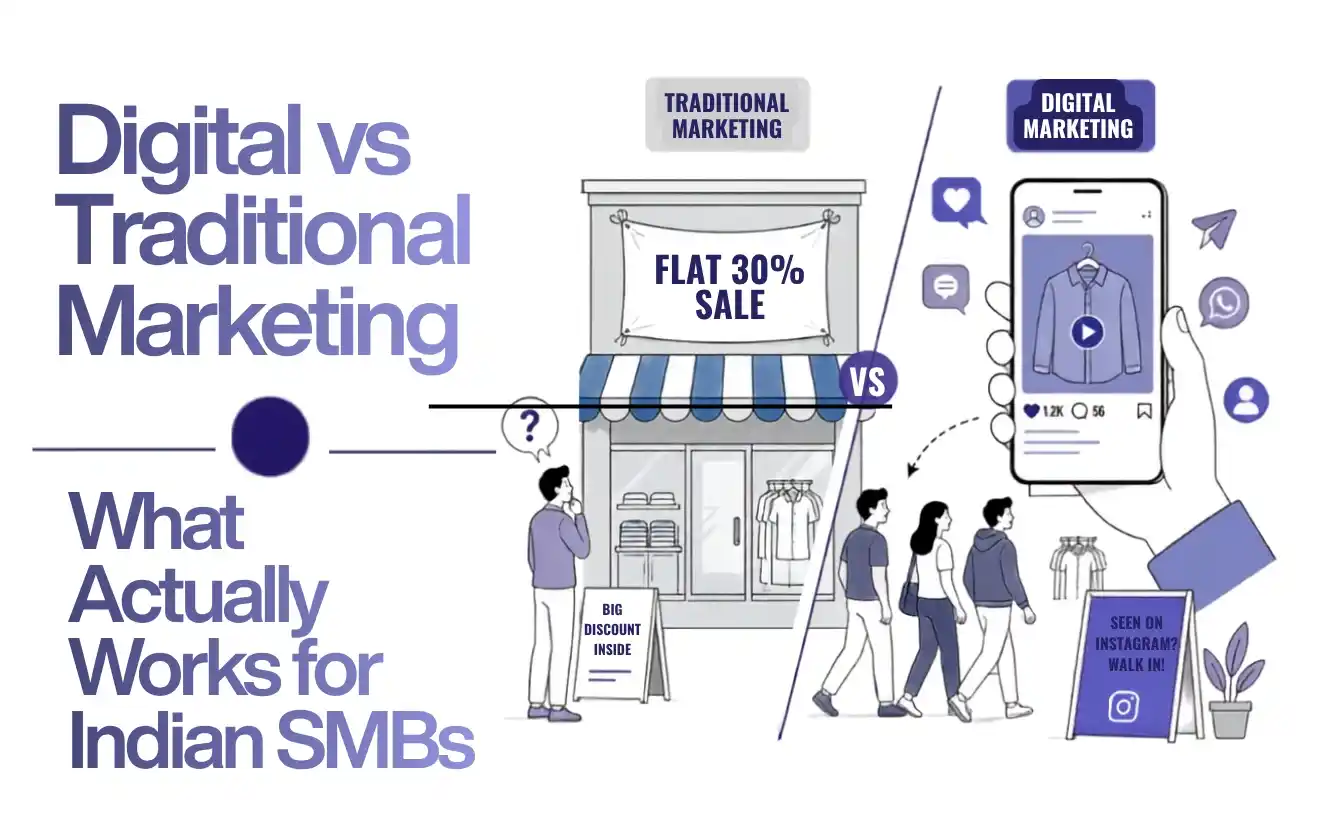
Rafiq adjusted the edge of the bright yellow banner hanging outside his clothing store in Lucknow.
“Flat 30% Sale,” it read in bold red letters.
He had spent good money printing it.
The colors were loud.
Impossible to miss.
By noon, the street outside was crowded.
Autos moved slowly through traffic.
Street vendors shouted over one another.
Shoppers walked past carrying bags and cold drinks in their hands.
Some people slowed down near the banner.
A few glanced at it.
Most kept walking.
Inside, the shop remained quiet.
Rafiq checked the entrance repeatedly, hoping someone would walk in because of the offer.
But the hours passed slowly.
Then, sometime around four in the evening, a college student entered the store.
He picked up a shirt from the display rack, checked the price tag, and immediately pulled out his phone.
“Bhaiya, I saw this on your Instagram,” he said, showing Rafiq a reel where the same shirt had been styled differently.
Rafiq blinked in confusion.
“Instagram?”
The boy nodded.
“Yeah. My friend shared it yesterday.”
A few minutes later, he bought the shirt without bargaining.
Paid full price.
Smiled.
And walked out.
Rafiq stood silently behind the counter for a moment.
Outside, his large yellow banner still hung across the storefront.
Same product.
Bigger discount.
More visible.
Yet somehow, it wasn’t the thing that had brought the customer inside.
And standing there between the silent banner and the glowing phone screen, Rafiq realised something uncomfortable.
Two kinds of marketing were happening at the same time.
But only one was actually influencing decisions.
That is the real conversation behind digital marketing vs traditional marketing in India today.
Because the question is no longer which one exists.
The question is which one truly changes customer behaviour.
Why Traditional Marketing Still Feels Familiar
For decades, businesses like Rafiq’s depended heavily on traditional marketing.
Banners.
Flyers.
Pamphlets.
Newspaper ads.
Local cable promotions.
Hoardings near busy roads.
These methods still feel familiar because they are physical.
You can see them.
Touch them.
Point at them.
There is comfort in that visibility.
When you hang a banner outside your shop, it feels like marketing is happening.
When thousands of pamphlets are distributed, it feels like your business is reaching people.
And to some extent, it still works.
Especially for local businesses trying to maintain visibility in crowded areas.
A signboard can help customers locate your store.
A newspaper advertisement can create awareness during festive seasons.
A hoarding near a market can remind people your business exists.
Traditional marketing is not useless.
But it comes with a major limitation.
You rarely know what happens after someone sees the advertisement.
Do they notice it?
Did they remember it?
Did they care enough to take action?
Or did they simply walk past it?
That uncertainty is where many businesses struggle.
Rafiq’s banner was visible all day.
But visibility alone did not create customer intent.
And that’s one of the biggest differences in the conversation around digital vs traditional marketing in India.
Why Digital Marketing Feels More Personal
When the student showed Rafiq the Instagram reel, something finally clicked.
The reel didn’t just display the shirt.
It showed someone wearing it.
Styling it.
Moving in it.
Laughing in it.
That changes how people respond emotionally.
Digital marketing works differently because it creates context.
Customers don’t just see products anymore.
They imagine themselves using them.
That emotional connection matters.
Especially for younger audiences who spend hours scrolling through Instagram, YouTube, and short-form content every day.
Platforms like Instagram, WhatsApp, Facebook, and Google Business Profile don’t simply broadcast information.
They create interaction.
Someone watches your reel.
They send it to a friend.
and They save it.
They message you.
and They check reviews.
They build trust before ever entering your store.
That entire process is part of modern customer behaviour.
And this is exactly why digital marketing has become so important for Indian SMBs.
Unlike traditional advertising, digital marketing leaves measurable signals behind.
You can track:
- Views
- Clicks
- Messages
- Website visits
- Product inquiries
- Conversions
- Customer engagement
That changes marketing completely.
Instead of guessing whether something worked, businesses can actually observe customer behaviour.
And for smaller businesses with limited budgets, that clarity matters.
The Real Difference Between Digital and Traditional Marketing
Many business owners treat digital and traditional marketing as competing choices.
But the reality is more nuanced.
They serve different purposes.
Traditional marketing builds physical presence.
Digital marketing builds mental preference.
A banner may remind someone your store exists.
But an Instagram reel may convince them your store is worth visiting.
A newspaper advertisement might create local awareness.
But customer reviews on Google often influence trust more deeply.
That’s the shift happening across India today.
Customers no longer make decisions only after entering a shop.
Most decisions begin much earlier.
On screens.
During searches.
Inside WhatsApp chats.
Through reels shared by friends.
That’s why digital vs traditional marketing in India is not really about old versus new.
It’s about understanding where influence happens first.
And increasingly, that influence begins online.
What Actually Works for Indian SMBs Today
After that day, Rafiq didn’t remove his banner.
But he stopped depending on it completely.
Instead, he started experimenting with digital content more seriously.
Short videos of new arrivals.
Behind-the-scenes clips.
Customer try-ons.
Festival collections.
Quick replies to WhatsApp enquiries.
He even encouraged happy customers to tag the store online.
At first, the changes felt small.
But slowly, footfall improved.
Not dramatically.
Steadily.
And more importantly, the customers walking in already knew what they wanted.
They had seen products online.
Compared styles.
Checked reviews.
Made decisions beforehand.
That changed the quality of customer interactions completely.
Rafiq spent less time convincing people.
More time selling.
That’s one of the biggest advantages digital marketing offers Indian SMBs today.
Better intent.
Not just broader visibility.
Why Attention Alone Is No Longer Enough
One of the biggest mistakes businesses still make is chasing attention without building connection.
Traditional marketing often focuses heavily on visibility.
Larger banners.
Brighter colors.
Bigger discounts.
Louder messaging.
But modern customers are overwhelmed with information already.
Attention alone is temporary.
Connection lasts longer.
Digital platforms allow businesses to build familiarity gradually.
Someone sees your reel today.
Checks your page tomorrow.
Messages you next week.
Visits your store later.
That repeated exposure builds trust.
And trust influences buying decisions far more effectively than one loud advertisement.
This is where many Indian SMBs are seeing real results from digital marketing.
Not because digital is magically better.
But because it aligns more closely with how customers now behave.
When Traditional Marketing Still Matters
Even with all this change, traditional marketing still has value.
Especially in hyperlocal markets.
A strong storefront still matters.
Good packaging still matters.
Local reputation still matters.
Word-of-mouth recommendations still matter enormously in India.
Offline visibility helps businesses stay present in the physical world.
But without digital support, that visibility often remains incomplete.
Because customers increasingly move between online and offline spaces before making decisions.
They discover online.
Then purchase offline.
Or they visit offline first and later check reviews online.
The customer journey is no longer linear.
That’s why the smartest businesses are not choosing one side completely.
They are combining both thoughtfully.
Coming Back to the Banner
A few weeks later, Rafiq replaced his old banner.
Not with brighter colors.
Not with a bigger discount.
But with a simple line:
“Seen on Instagram? Walk in.”
That small sentence reflected a much bigger shift.
It wasn’t the banner itself changing his business.
It was what the banner now pointed toward.
That evening, another group of college students walked into the store.
They were already discussing which shirts they had seen online.
Rafiq didn’t need to convince them anymore.
The decision had already started before they entered.
Somewhere between a scroll, a share, and a saved post.
He stood behind the counter again.
Same shop.
and street.
Same customers passing outside.
But now he understood something he hadn’t understood before.
Marketing isn’t about choosing between old and new.
It’s about understanding where your customer is paying attention when the decision is being made.
Because today, the real competition isn’t always the shop next door.
It’s the screen in your customer’s hand.
And in the debate around digital vs traditional marketing in India, the businesses that understand this shift early are often the ones customers remember first.
Reference
Small Business Digital Marketing Guides