Open Search Console for one of your top informational pages and look closely. Impressions might be holding steady, or even climbing, while clicks quietly drift downward. That’s not a tracking bug. That’s AI overviews zero-click search doing exactly what it’s built to do, answering the question directly on the results page and giving a real percentage of searchers no reason to click through at all.
For years, the top of the funnel assumed a click was the starting point. Someone searches, clicks, lands on your page, and the relationship begins there. That assumption is breaking down for a meaningful slice of queries, and pretending otherwise means building a funnel with a hole in it that keeps getting bigger.
What’s Actually Happening
AI overviews sit at the top of many search results now, synthesizing an answer directly from multiple sources before a single traditional link even appears. For informational queries, definitions, quick facts, straightforward how-to questions, this answer often fully satisfies the person searching. There’s no unresolved need pulling them further down the page.
The result is AI overviews zero-click search behavior at scale: rising impressions, since your content might still be one of the sources feeding that overview, paired with falling click-through rates, since fewer people need to click anywhere once they’ve read the summary. Impressions and clicks used to move together. Now they’re increasingly decoupled, and a lot of teams are still reading their reports as if that decoupling isn’t happening.
Why This Breaks the Traditional Funnel
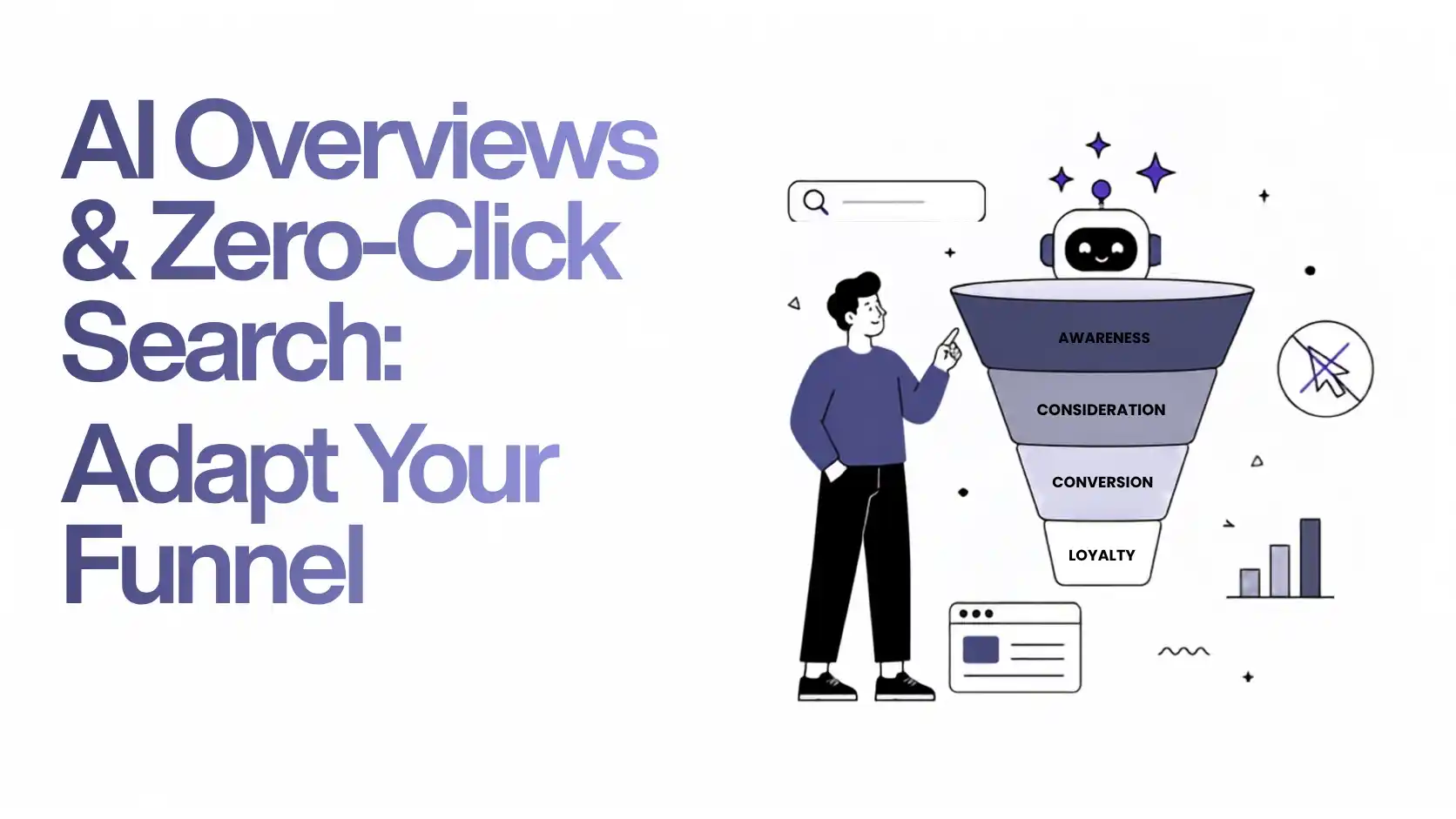
The classic funnel treated the click as step one: awareness through search, then a landing page introducing your brand, then nurturing toward a conversion. If that first click doesn’t happen, everything downstream in that model never gets a chance to start. Someone gets their answer from an overview, forms zero impression of your brand specifically, and moves on without ever entering what used to be your funnel at all.
This hits certain content types harder than others. Purely informational pages, built to answer a single, well-defined question, are the most exposed, since they’re exactly the content type AI overviews are best at summarizing directly. Pages built around comparison, opinion, original analysis, or genuine complexity tend to hold up better, since a short synthesized answer can’t fully replace that kind of depth.
Adapting Where the Click Still Happens
Not every query is being absorbed into zero-click answers, so the first move is figuring out which of your queries and pages are actually affected. Compare impressions and click-through rate trends for your key informational pages against your comparison, opinion, and deeper analytical content. If the gap between rising impressions and falling clicks is concentrated in your purely informational pages, that confirms where AI overviews zero-click search is actually eating into your funnel versus where it isn’t yet a major factor.
For the pages still driving real clicks, protect and strengthen what makes them worth visiting beyond a quick answer, deeper context, tools, calculators, comparisons, things a short AI summary genuinely can’t replace. This is where investing further effort still pays off in the traditional sense.
Adapting Where the Click Doesn’t Happen
For content that’s increasingly being absorbed into zero-click answers, the smarter move is treating visibility inside the overview itself as the goal, since being the cited source there still carries real brand value even without a click, as covered in depth elsewhere in AEO and GEO. Structuring these pages for clean extraction, with direct answers near the top and clear entity naming, increases the odds you’re the source being pulled from, rather than a competitor.
It’s also worth building brand awareness into that content deliberately, in ways a summary can still carry even without a click. If your brand name or a distinctive stat naturally shows up as part of a clean, quotable answer, that detail sometimes survives into the overview itself, which is a small but real form of exposure even without a visit.
Rethinking Where Your Funnel Actually Starts
Here’s the harder shift. If a meaningful share of your top-of-funnel queries increasingly resolve without a click, the entry point to your funnel needs to move further down for that segment. That might mean investing more heavily in comparison and decision-stage content, the queries less likely to be fully answered by a short overview, since that’s where the click, and the beginning of an actual relationship, is more likely to still happen.
It can also mean leaning more on channels less exposed to this shift, email, communities, direct partnerships, places where you’re not depending on someone clicking through from a search results page that might already have answered their question before they ever saw your listing.
Measuring Success Differently
Traffic alone stops being a complete picture here. Track impression and citation visibility for your key informational queries even where clicks are declining, since that still represents real reach and brand exposure, just not the kind your existing dashboards were built to show clearly. Pair that with closer tracking of your deeper, comparison-stage content, where clicks still translate more directly into pipeline.
Reference
The Bottom Line
AI overviews zero-click search isn’t a temporary glitch to wait out. It’s a structural shift in how a meaningful share of informational queries get resolved, and funnels built entirely around the assumption of a click are going to keep leaking at the top for exactly this content type. The fix isn’t panic, it’s redirecting effort: protect and deepen the content still earning clicks, optimize purely informational content for citation and visibility instead, and shift where your funnel actually starts to match where the click still reliably happens.