

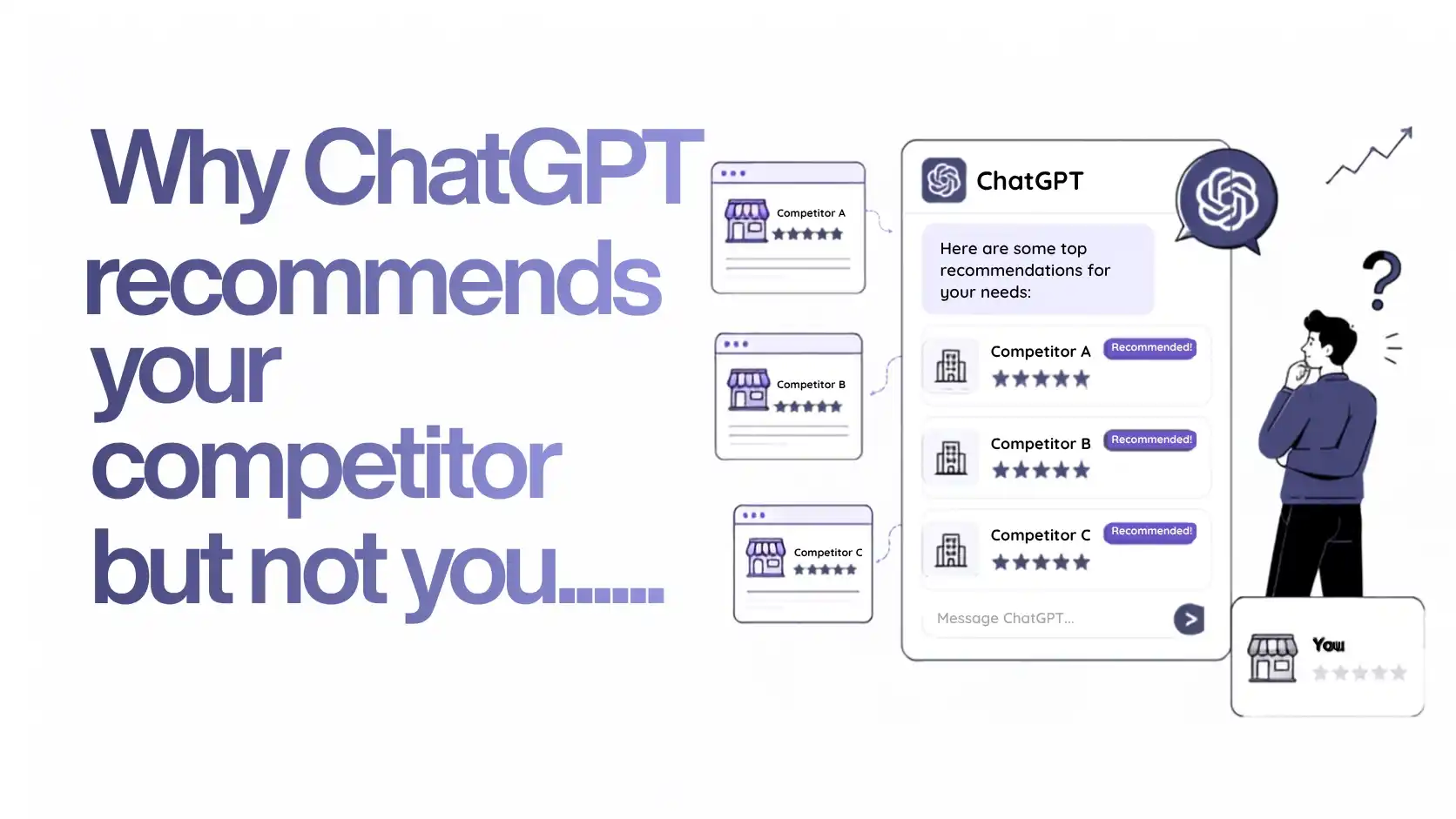
Every business owner has typed a question into ChatGPT or Google’s AI Overview at some point and noticed the same handful of brands showing up again and again. It rarely feels random, and it isn’t.
There is a clear, measurable difference between the businesses that get named by AI assistants and the ones that never make the list, and that difference has a name now: Answer Engine Optimization, or AEO. If SEO was ever about earning a blue link on page one, Answer Engine Optimization is about earning a mention inside the actual answer, whether that answer comes from ChatGPT, Perplexity, Google’s AI Mode, or Gemini.
Why Answer Engine Optimization Is Worth Your Attention Right Now
The shift matters more than most business owners realize. AI search still sends a small slice of total traffic compared to traditional Google search, but that slice converts at a dramatically higher rate.
Ahrefs recently shared its own numbers on this: AI search made up less than one percent of its total visitors, yet those visitors accounted for over twelve percent of new signups, converting at roughly twenty-three times the rate of a typical organic search visitor. When someone reaches your website through an AI assistant, they have already been vetted, compared, and recommended before they ever click. That is a warmer lead than almost any other channel produces, which is exactly why ignoring Answer Engine Optimization in favor of only chasing rankings is starting to look shortsighted.
How AI Assistants Actually Decide Who to Mention
Understanding how AI assistants pick who to mention starts with a concept called query fan-out. Instead of matching one search term to one page the way traditional search engines do, AI models break a single question into dozens of smaller sub-questions behind the scenes, research each one, and then stitch together a single response.
A simple prompt like planning a trip to Japan quietly spins off searches about neighborhoods, weather, itineraries, and packing lists, all happening at once. This means your content doesn’t need to rank for one perfect keyword anymore. It needs to be the clearest, most trustworthy answer to one of the dozens of smaller questions the AI is asking on the user’s behalf.
The Three Patterns Behind Every AI Citation
Once you accept that framing, three patterns show up consistently in what gets pulled into AI answers.
The first is consensus. When multiple independent sources describe your product, your service, or your industry the same way, AI models treat that agreement as a signal of accuracy and lean toward repeating it.
The second is freshness. Ahrefs analyzed the age of pages cited across ChatGPT, Perplexity, Copilot, and Gemini and found the average cited page was published about two point nine years ago, compared with roughly three point nine years for pages ranking organically in Google. Content that gets revisited and updated regularly has a real edge here.
The third is format. Certain page types get pulled into AI answers far more often depending on the industry, with blog posts and blog-style content performing especially well for agencies and service businesses, while product pages carry more weight for ecommerce brands.
The Word Count Myth in Answer Engine Optimization
There’s a persistent myth that AI assistants prefer short, thin content because of limited context windows, and it simply doesn’t hold up. Ahrefs studied over one hundred and seventy thousand pages cited in AI Overviews and found almost no relationship between word count and the likelihood of being cited, with a correlation so close to zero it was statistically meaningless.
The average length of cited content came out to around 1,282 words, only slightly above the roughly 1,188 word average for organically ranking content, and more than half of all cited pages were actually under 1,000 words. The real lesson is to write exactly as much as the topic honestly requires for a human reader, then stop. Padding an article to hit an arbitrary word count does nothing for your visibility in AI answers and often hurts the reading experience that got you cited in the first place.
Content Habits That Strengthen Answer Engine Optimization
What actually shapes how AI models write about a topic comes down to a handful of content habits that sit at the core of good Answer Engine Optimization practice.
Leading with the answer first, a principle often shortened to BLUF or “bottom line up front,” matters because AI systems tend to extract the most direct statement in a passage rather than piecing together an answer buried three paragraphs deep in a slow, scene-setting introduction. Writing in atomic, self-contained chunks helps too, where each paragraph or section can stand alone and be pulled out of context without losing meaning.
Being specific and entity-rich beats being vague every time. Saying a keyword research tool “helps you find keywords with low difficulty and high traffic potential” gives an AI model something concrete to repeat, while saying a tool simply “helps with SEO” gives it nothing worth quoting. Simple, declarative sentences also tend to get picked up more often than long, qualifier-heavy ones, since AI models generally favor shorter sentence structures when constructing an answer.
Earning Mentions You Don’t Fully Control
Getting cited on your own website is only half the picture, because AI models weigh what other people say about your brand just as heavily as what you say about yourself.
This is where mentions on third-party pages become critical: coverage from industry publications, reviews on trusted comparison sites, and even conversations on community platforms like Reddit all feed into how AI assistants describe a brand. Reddit in particular shows up as one of the single most cited domains across ChatGPT responses globally, alongside Wikipedia and Amazon, which means a handful of genuine, well-answered questions in relevant subreddits can carry real weight.
One of the most reliable ways to earn these third-party mentions is still original research. Running a small study, survey, or benchmark on a question your audience already cares about gives journalists, bloggers, and other sites something worth citing, which builds exactly the kind of external validation that strong Answer Engine Optimization depends on.
The Surprising Power of YouTube
Perhaps the most surprising finding from Ahrefs’ broader analysis of roughly seventy-five thousand brands is just how much weight YouTube carries in all of this. YouTube mentions showed the strongest correlation with AI visibility out of every factor measured, outperforming branded search volume, domain rating, and even the total number of pages on a website.
Classic authority metrics that used to dominate SEO conversations, like backlink count or overall site size, barely moved the needle on AI visibility by comparison. Practically, that means investing time in a YouTube channel, even a modest one built around answering the exact questions your customers ask, may do more for how AI assistants perceive your brand than another round of blog posts ever will.
Simple habits like placing your target keyword naturally in the video title and description, adding timestamped chapters, and actually saying the keyword out loud during the video all help YouTube’s own systems and AI crawlers understand what the video covers. Ahrefs breaks down the full data behind this finding on its blog, which is worth a read if you want the underlying numbers.
The Technical Side of Answer Engine Optimization
None of this works if AI systems can’t reach your content in the first place, which brings up the technical side of Answer Engine Optimization that’s easy to overlook.
AI companies run their own crawlers, GPTBot for OpenAI, ClaudeBot for Anthropic, Google-Extended for Google, and several others, and every one of them respects your site’s robots.txt file. Some hosting and security tools, including Cloudflare, now block AI bots from crawling a site by default as a privacy measure, which is a smart setting for many businesses but a silent trap for one that’s actively trying to build AI visibility. It’s worth checking your own robots.txt file and any security dashboard you use to make sure you haven’t accidentally shut the door on the very bots that would otherwise be reading and citing your content.
On the measurement side, most AI referral traffic still shows up as a vague “referral” or gets bundled into direct traffic inside Google Analytics unless you deliberately set up channel groupings to isolate it. It’s worth checking whether your GA4 setup can actually see this traffic before assuming it isn’t there.
Where This Leaves Small and Mid-Sized Businesses
Taken together, Answer Engine Optimization isn’t a replacement for SEO so much as an expansion of what “ranking” even means. The businesses that show up when someone asks ChatGPT for a recommendation are the ones publishing clear, current, specific content, showing up in conversations they don’t fully control on Reddit and review sites, building a real presence on YouTube, and making sure their technical setup doesn’t quietly block the very systems doing the recommending.
For small and mid-sized businesses especially, this is genuinely good news: none of it requires the budget of a Fortune 500 company, just a willingness to write clearly, publish consistently, and show up in the conversations already happening about your industry.
If you’re not sure whether your site is currently visible to AI crawlers, or want a clearer picture of how your brand shows up across ChatGPT, Gemini, and Google’s AI Overviews, that’s exactly the kind of Answer Engine Optimization audit TechVint runs for clients before building out a content and visibility strategy around it.
Reference
Frequently Asked Questions ( FAQs):-
1. What is Answer Engine Optimization (AEO)?
Answer Engine Optimization (AEO) is the practice of optimizing content so AI-powered search engines like ChatGPT, Google AI Overviews, Gemini, and Perplexity can understand, trust, and cite your website in their answers.
2. How is Answer Engine Optimization different from SEO?
SEO focuses on ranking webpages in search engine results, while Answer Engine Optimization focuses on getting your content referenced directly in AI-generated answers and recommendations.
3. Why is Answer Engine Optimization important for businesses?
AEO helps businesses increase visibility in AI search platforms, attract highly qualified visitors, build brand authority, and generate more conversions from AI-powered recommendations.
4. How can I improve my website for Answer Engine Optimization?
You can improve AEO by publishing clear, accurate, and well-structured content, updating information regularly, using schema markup, building brand mentions, and ensuring AI crawlers can access your website.
5. Which AI platforms benefit from Answer Engine Optimization?
Answer Engine Optimization helps improve visibility across ChatGPT, Google AI Overviews, Google AI Mode, Gemini, Perplexity AI, Microsoft Copilot, and other AI-powered search assistants.
6. Does Answer Engine Optimization replace traditional SEO?
No. Answer Engine Optimization complements traditional SEO. A strong SEO strategy provides the foundation, while AEO increases your chances of being cited in AI-generated responses.
7. Does content length matter for Answer Engine Optimization?
Not necessarily. AI models prioritize helpful, accurate, and well-organized content over word count. Focus on answering the user’s question completely rather than writing longer articles.
8. Do AI crawlers need access to my website?
Yes. AI crawlers like GPTBot, Google-Extended, and ClaudeBot need permission to crawl your website. Blocking these bots can reduce your chances of appearing in AI-generated answers.
9. How do AI assistants decide which websites to cite?
AI assistants evaluate factors such as content quality, accuracy, freshness, authority, structured information, trusted third-party mentions, and overall relevance before citing a source.
10. How long does it take to see results from Answer Engine Optimization?
Results vary based on your industry, competition, and content quality. Consistently publishing authoritative content and improving your website’s credibility can lead to increased AI visibility over time.