

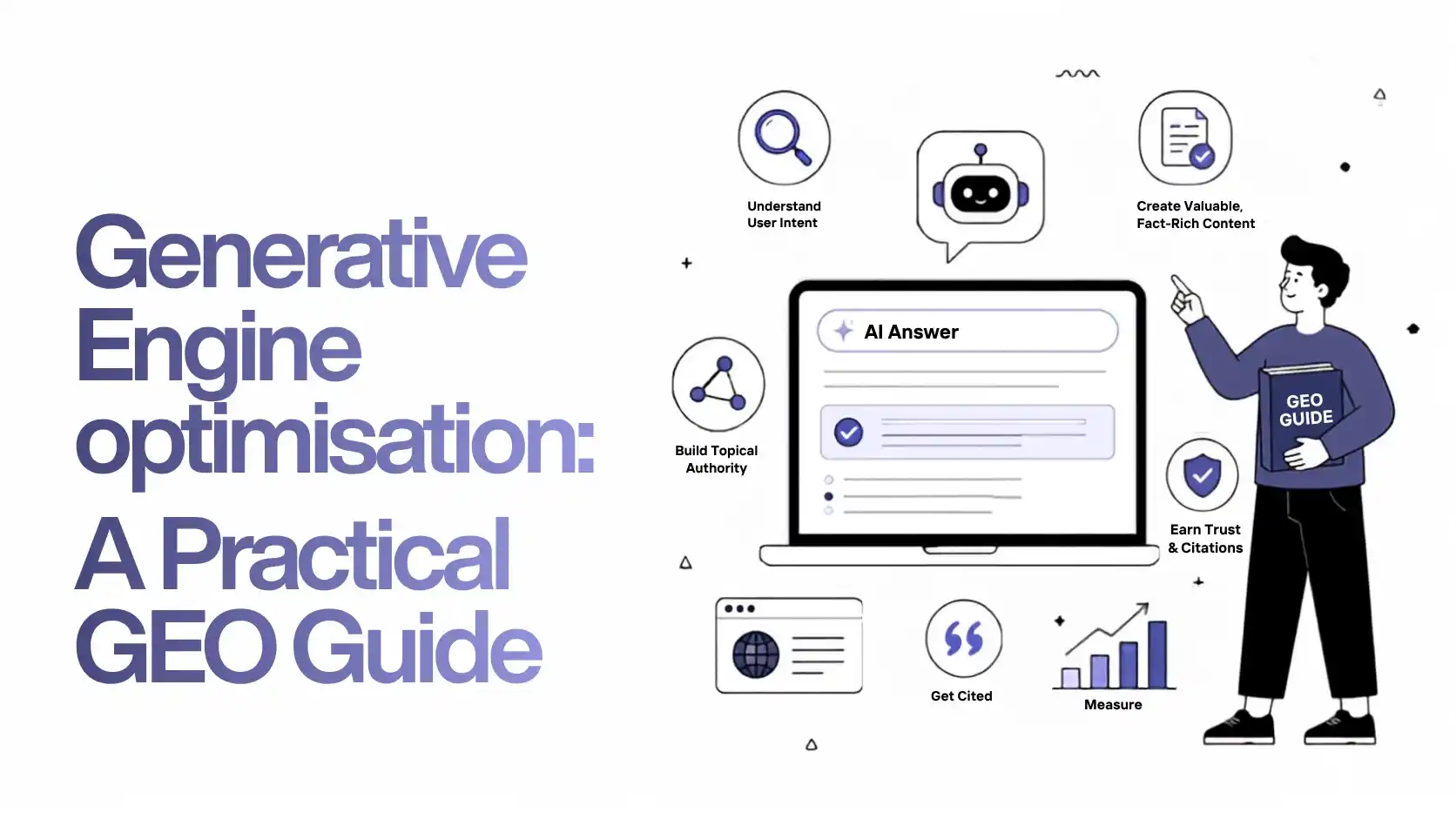
A few years ago, GEO “ranking on page one” was the whole game. Now there’s a second game running alongside it, quieter, less measured, but growing fast: getting cited inside an AI chat response instead of showing up as a blue link at all. Someone asks ChatGPT a question, gets a synthesized answer with a few sources listed underneath, or none at all, and never opens a single website. That’s the moment generative engine optimization is built around.
If you’ve been treating this as just SEO with new branding, it’s worth slowing down. The mechanics behind how ChatGPT, Perplexity, and Gemini decide what to cite are different enough from traditional ranking factors that a dedicated approach actually pays off. Here’s a practical starting point.
What is GEO (Generative Engine Optimisation)
Actually Means?
Generative engine optimization is the practice of structuring and positioning your content so AI tools that generate synthesized answers, rather than just listing links, are more likely to reference, quote, or cite you as a source. That’s a meaningfully different target than traditional search rankings, which are ultimately about earning a click.
Each of these tools works a little differently under the hood. Perplexity leans heavily on real-time web retrieval and tends to cite sources fairly transparently, showing numbered references alongside its answers. ChatGPT’s browsing and search features pull from the live web when needed but blend that with its own trained knowledge, which means citation behavior can be less predictable. Gemini, tightly integrated with Google’s own search infrastructure, often draws on similar signals to traditional search while adding its own synthesis layer on top.
Understanding these differences matters because a page that performs well GEO for one might not automatically perform well for another, even though the underlying principles overlap considerably.
The Common Thread Across All Three
Despite their differences, all three systems are fundamentally trying to answer the same question about any given source: is this clear, credible, and specific enough to be worth citing directly. That shared question is where most of your generative engine optimization effort should focus, rather than chasing platform-specific tricks.
Clarity means structuring content so a direct answer sits close to the question it addresses, not buried under a long introduction. Credibility means demonstrating real expertise, through author information, citations of your own, and evidence of firsthand knowledge rather than repackaged summary. Specificity means including concrete details, actual numbers, named examples, original data, that a generic AI-generated answer wouldn’t already contain on its own.
Practical Steps to Start With
Begin by auditing how your brand and content currently show up, or don’t, across these tools. Ask each of them several real questions your target audience would ask, questions your content is meant to answer, and note whether you’re cited, paraphrased anonymously, or absent entirely. This gives you an honest baseline before you invest further effort.
From there, focus on restructuring your strongest existing content first rather than starting from scratch. Pull direct, self-contained answers to the top of relevant sections. Make sure your most valuable, specific insights aren’t buried at the end of a long piece as a kind of reward for persistent readers.
Strengthen your credibility signals sitewide. Clear author bylines with real expertise, accurate publish and update dates, and genuine original data all feed into whether these systems treat you as a trustworthy source worth citing rather than one more page saying roughly the same thing as everyone else.
Add structured data where it genuinely applies, particularly FAQ and HowTo schema, since this gives these systems an explicit, unambiguous map of your content’s structure rather than forcing them to infer it.
What Doesn’t Work Here
Keyword stuffing, in any of its old-school forms, does essentially nothing for generative engine optimization. These systems aren’t matching on keyword density. They’re evaluating whether a passage genuinely and clearly answers a question, which makes precision far more valuable than repetition.
Thin, templated content built purely to cover a topic without adding anything specific tends to get skipped over even when it technically contains the right information, since these systems are actively trying to identify sources that add something beyond generic knowledge they could generate unprompted.
Chasing every platform’s specific quirks before getting the fundamentals right is also a common misstep. A site with clear structure, real credibility signals, and genuinely specific content tends to perform reasonably across all three tools, since the underlying qualities they’re evaluating overlap far more than they diverge.
Measuring Whether It’s Working
Traditional analytics won’t fully capture this. Track citation and mention frequency directly by periodically testing your target questions across these tools and logging the results over time. It’s manual and a little tedious right now, since polished tracking tools for this are still maturing, but it’s the most direct signal available.
Also keep an eye on referral traffic patterns from these platforms where they do send clicks, since that data can reveal which of your pages are already performing well here, giving you a template for what to replicate elsewhere on your site.
Reference
The Bottom Line
Generative engine optimization isn’t about gaming ChatGPT, Perplexity, or Gemini individually. It’s about building content clear, credible, and specific enough that any of them would reasonably choose to cite it. Start by auditing where you currently stand, restructure your strongest content for direct extraction, strengthen your credibility signals, and measure citation frequency directly since traditional traffic metrics won’t tell the full story here
Frequently Asked Questions
Q: What is Generative Engine Optimization (GEO), and how is it different from traditional SEO?
A: Generative Engine Optimization (GEO) focuses on making your content more likely to be cited or referenced by AI-powered search tools like ChatGPT, Gemini, and Perplexity. While traditional SEO aims to rank web pages in search results and earn clicks, GEO is about creating clear, credible, and specific content that AI systems can confidently use in their generated answers.
Q: How can I improve the chances of ChatGPT or Gemini citing my website?
A: Start by providing direct answers to common questions, supporting your content with original insights, data, and real expertise. Strong author profiles, updated content, and structured data such as FAQ or HowTo schema also help AI systems better understand and trust your pages.
Q: Does keyword stuffing help with Generative Engine Optimization?
A: No. AI search systems prioritize content that clearly answers a user’s question instead of counting how many times a keyword appears. Writing naturally, adding unique value, and organizing information logically are far more effective than repeating the same phrases.
Q: Should I create new content for GEO or optimize my existing pages?
A: In most cases, optimizing your existing high-performing content is the smarter first step. Restructuring articles with concise answers, improving readability, and strengthening credibility signals can often produce better results than publishing large amounts of new content.
Q: How do I measure whether my GEO strategy is working?
A: Traditional SEO metrics alone won’t tell the full story. Regularly test important customer questions in AI tools to see whether your brand is cited, monitor referral traffic from AI platforms where available, and track changes in citation frequency over time to measure progress.
Q: Do I need a different GEO strategy for ChatGPT, Perplexity, and Gemini?
A: While each platform retrieves and cites information differently, the core principles remain the same. Content that is clear, trustworthy, well-structured, and backed by real expertise has the best chance of being referenced across all major AI search platforms, making a strong foundation more valuable than chasing platform-specific tactics.