

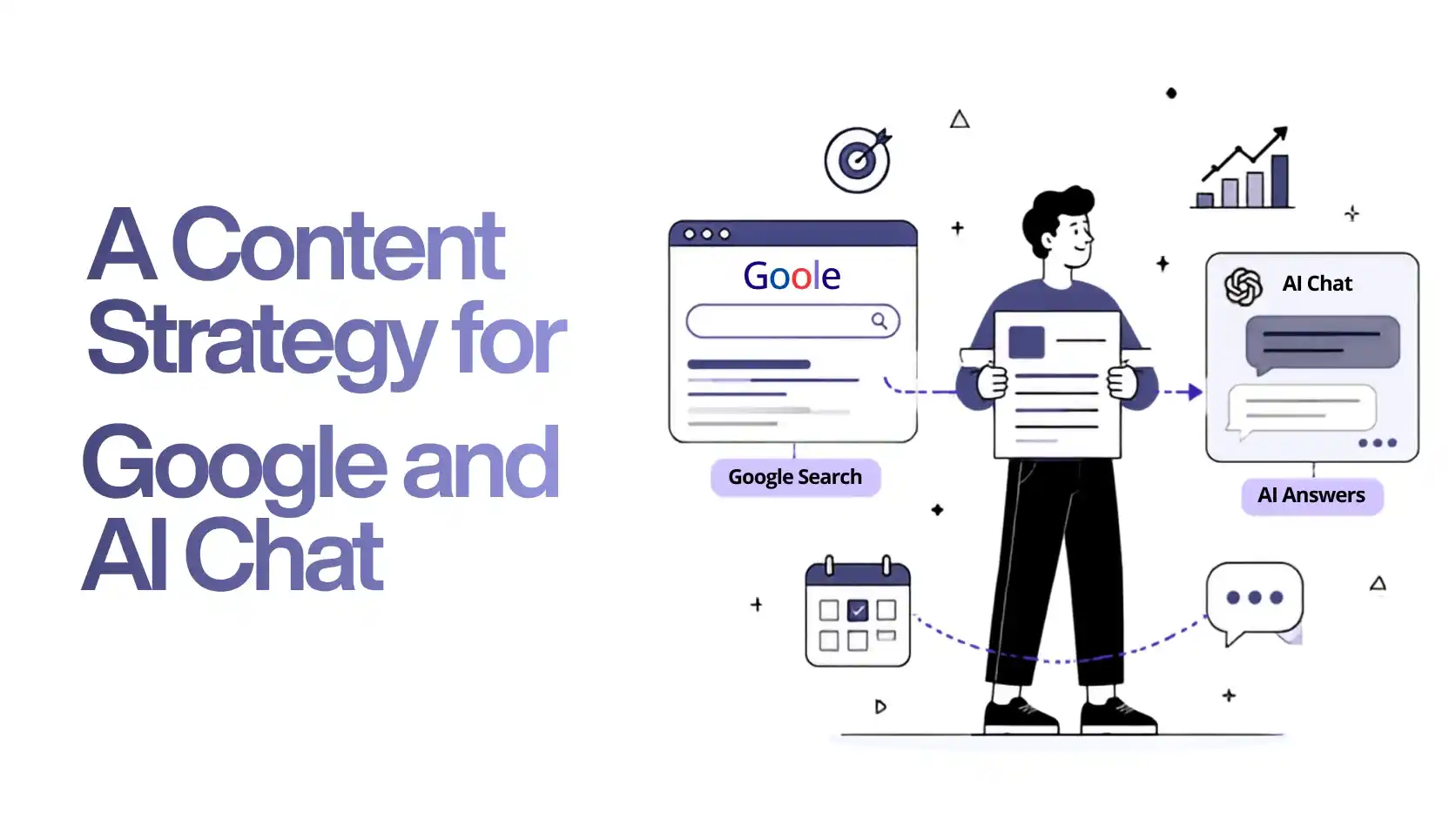
Most content still gets built for one reader: Google’s crawler. But a real AI search content strategy in 2026 has to satisfy two very different systems at once — a ranking algorithm and a set of retrieval engines that quote, summarize, and cite instead of listing links. ChatGPT Search alone handles somewhere between 250 and 500 million queries a week, and it doesn’t rank your page — it lifts a passage from it. Writing for both audiences at once is now the actual job.
Why One Format No Longer Covers Both
Google and AI chat interfaces read content differently, and the gap is wider than most teams assume. Google still crawls a full page and scores it against hundreds of ranking factors, rewarding depth, internal linking, and long-term authority signals. ChatGPT and Perplexity work more like extraction engines: they pull a specific passage, decide in seconds whether it directly answers the question, and cite it or move on. Only about 11% of domains get cited by both ChatGPT and Perplexity, which is a strong signal that these engines don’t share a single playbook — a page tuned for one can be functionally invisible to the other.
The retrieval mechanics matter too. ChatGPT Search runs on a Bing-based backend and shows a clear preference for listicle-style formatting, which accounts for a large share of the pages it cites. Perplexity uses its own index, weights content freshness far more heavily than Google does, and retrieves at the snippet level rather than the page level — meaning a single well-written paragraph can earn a citation even if the rest of the page is average. Google, by contrast, is still evaluating the page as a whole document, weighing backlinks, topical authority, and technical signals that have nothing to do with any single sentence. Building an AI search content strategy that works everywhere means designing for both behaviors on purpose, not assuming Google-friendly content will translate automatically.
It’s worth being clear about where most AI citations actually come from, too. A large share of what ChatGPT and Perplexity cite is earned through third-party mentions — press coverage, forums, comparison sites, industry roundups — rather than a brand’s own website. That doesn’t make on-site optimization pointless, but it does mean an AI search content strategy can’t stop at the homepage; a chunk of the work is about being mentioned favorably in the places these engines already trust.
What AI Engines Actually Reward
A pattern shows up across independent studies of what gets cited and what doesn’t. Position matters most: a large share of ChatGPT citations come from roughly the first third of a page’s text, so answers buried under throat-clearing intros rarely get pulled. Confidence matters almost as much — cited passages are nearly twice as likely to use direct, definitive language instead of hedged phrasing, since retrieval systems struggle to extract a clean answer from vague writing. Freshness is its own signal, particularly for Perplexity, which favors recently updated content noticeably more than Google does; a meaningful share of AI bot crawler activity targets pages published or updated within the past year. And structure is rewarded across the board — schema markup, especially FAQ and HowTo schema, is one of the strongest measurable predictors of getting cited by ChatGPT, and clear headings phrased as real questions help every engine match content to a query faster.
The “Answer-First” Approach
The single most consistent piece of advice across current AI search content strategy research is to write the answer before the explanation, not after it. Open each major section with a direct, self-contained answer in roughly 40 to 60 words, then follow with supporting detail, context, or nuance underneath. This isn’t just good practice for AI engines — it also improves how a human skims the page, which is part of why it doesn’t hurt traditional SEO performance either. A useful test here is what some GEO
( generative engine optimisation ) practitioners call the “island test”: take any paragraph on the page, remove everything around it, and check whether it still makes sense on its own. Passages that open with “It,” “This,” or “They” usually fail that test, because they depend on context an extraction engine won’t carry over. Rewriting those openers to name the subject directly is one of the highest-leverage, lowest-effort fixes available.
Structuring Content for Dual Discovery
A page built for an AI search content strategy needs to work at two zoom levels at once — the whole-page level Google evaluates and the single-passage level AI engines extract from. That means keeping the traditional fundamentals intact: solid keyword targeting, internal linking, technical health, and page experience still drive classic rankings and shouldn’t be sacrificed for AI formatting. On top of that foundation, each major heading should function as a mini-answer in its own right, opening with a direct statement rather than easing into the topic. Named statistics, sourced data, and specific numbers should sit near the top of sections rather than buried in the conclusion, since that’s the material extraction engines are most likely to quote. Structured formats — short lists, clearly separated FAQ blocks, comparison-style breakdowns in prose rather than dense paragraphs — make it easier for both Google’s rich results and AI retrieval systems to parse a section cleanly. And every priority page needs a visible, schema-marked update date, since freshness is one of the few signals every major AI engine treats as important, even when they disagree on almost everything else.
Measuring What’s Actually Working
Traditional rank tracking doesn’t capture AI visibility, because there’s no “position one” inside a chat interface. A functional AI search content strategy needs its own measurement layer. Referral traffic from AI sources shows up in analytics under referrers like chatgpt.com or perplexity.ai, and a rising trend there is one of the clearest signs a strategy is working. Manual citation testing — running priority keywords through ChatGPT and Perplexity and logging whether a domain shows up — is tedious but still the most direct way to check citation share against competitors. Branded search volume is a useful proxy metric too: when AI tools mention a brand by name without linking to it, users often turn around and search the brand directly, which shows up as a lift in Google Search Console even though the AI engine sent no click at all. Treating these three signals — AI referral traffic, citation testing, and branded search lift — as a standing part of monthly reporting is what separates a real AI search content strategy from a one-time formatting exercise.
Bringing It Together
The businesses treating “SEO” and “AI search optimization” as two separate projects are already behind. A working AI search content strategy for 2026 keeps everything that made content rank well on Google — depth, structure, internal linking, technical health — and layers an extraction-first discipline on top of it: answer early, write with confidence, keep pages fresh, and mark up content so machines can parse it as easily as people can. Google and AI chat interfaces will keep pulling further apart in how they retrieve and present information, but a page built with both readers in mind from the start doesn’t have to choose between them.
Frequently Asked Questions
Q: What is an AI search content strategy?
A: An AI search content strategy is the process of creating content that performs well in both traditional search engines and AI-powered search tools like ChatGPT, Perplexity, and Gemini. It combines SEO best practices with content formatting that makes answers easy for AI systems to extract, summarize, and cite.
Q: How is writing for AI search different from traditional SEO?
A: Traditional SEO focuses on improving rankings and earning clicks from search results, while AI search prioritizes extracting clear, trustworthy answers from individual passages. This means content should provide direct answers early, use descriptive headings, and include specific facts that AI tools can confidently reference.
Q: What is the “answer-first” approach in AI content optimization?
A: The answer-first approach places a concise, standalone answer at the beginning of each major section before expanding with additional context. This structure helps AI retrieval systems identify the key information quickly while also making the content easier for human readers to scan.
Q: Can one piece of content rank well on Google and be cited by AI tools?
A: Yes. The strongest content is designed to satisfy both search engines and AI assistants by combining solid SEO fundamentals with clear, extractable answers. Maintaining technical SEO, internal linking, and topical authority while improving readability and structure gives content the best chance of succeeding across both search experiences.
Q: How can I increase the chances of ChatGPT or Perplexity citing my content?
A: Write clear and confident answers, place important information near the top of each section, support claims with credible sources, and keep your content updated. Adding structured data such as FAQ and HowTo schema can also make it easier for AI systems to understand and reference your pages.
Q: How do I measure the success of an AI search content strategy?
A: Don’t rely on keyword rankings alone. Monitor referral traffic from AI platforms, regularly test whether your pages are cited for important queries, and track branded search growth in Google Search Console. Together, these metrics provide a clearer picture of how visible your content is across both traditional and AI-powered search.