

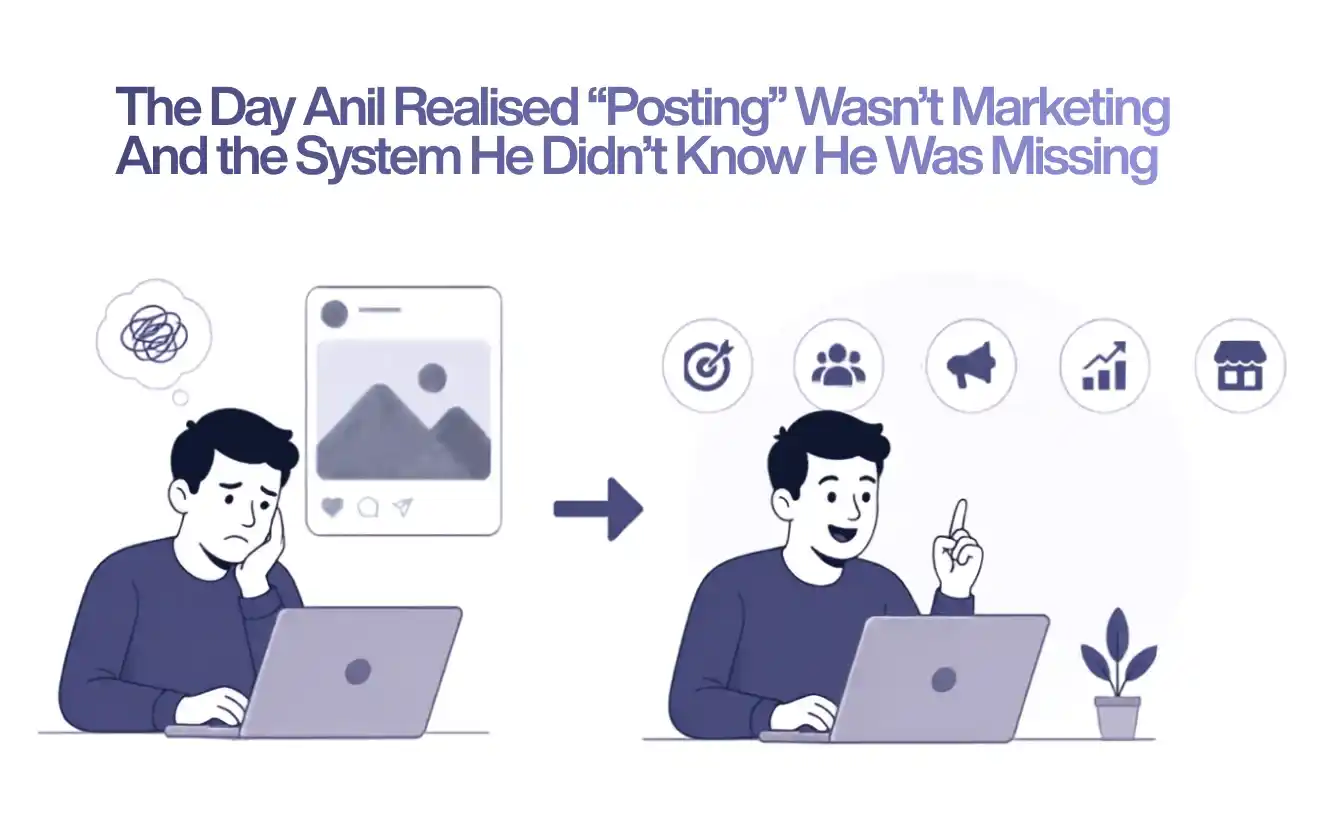
The Day Anil Realised “Posting” Wasn’t Marketing
And the System He Didn’t Know He Was Missing
What looks simple on the surface often hides the work that actually drives results. That is why a strong Digital Marketing Strategy India businesses can follow consistently matters far more than random posting or occasional advertisements.
Anil stood outside his hardware store in Coimbatore, watching a delivery truck reverse slowly into the narrow lane.
Inside, shelves were stacked with pipes, fittings, paint cans, and tools. Everything a contractor or homeowner might need sat neatly arranged across the walls.
His son leaned against the counter, scrolling through Instagram on his phone.
“Appa, we should be on Instagram,” he said casually. “Everyone is there.”
Anil shrugged. “We already made an account, no?”
“Yes,” his son replied. “But you actually have to post regularly.”
That evening, Anil tried.
He clicked photos of products. Uploaded them. Added prices. Replied to a couple of comments.
The next morning, he checked again.
A few likes.
No calls.
No customers mentioning the page.
After a few days, he stopped completely.
Standing inside his shop one afternoon, he concluded something many business owners quietly believe.
“This online marketing… it’s just posting. And honestly, it doesn’t work.”
But what Anil tried was not digital marketing.
It was only a tiny fragment of it.
That is where many businesses misunderstand the idea of a Digital Marketing Strategy India companies actually need. From the outside, digital marketing looks simple because most of the important work happens invisibly in the background.
A Digital Marketing Strategy India Businesses Need Is a Connected System
When people hear “digital marketing agency,” they usually imagine someone managing Instagram pages or running Facebook ads.
But that is only one part of the process.
The real job of a digital marketing agency is to create a connected system that guides customers from discovery to decision.
Think about how people buy today.
They search on Google, check reviews.
and visit Instagram profiles, compare competitors.
They ask questions on WhatsApp.
Only then do they decide whether to visit or purchase.
Each of those moments becomes a touchpoint.
A touchpoint is simply any interaction a customer has with your business online.
A proper Digital Marketing Strategy India businesses follow works on all these touchpoints together instead of treating them separately.
Why Customers Decide Before They Contact You
Anil believed customers made decisions after entering his store.
But modern buying behaviour works differently now.
Customers often decide long before they walk inside.
When someone searches “hardware store near me,” Google becomes the first impression,
while your Instagram posts shape trust and your WhatsApp response speed builds confidence.
Every small interaction quietly influences the final decision.
That is why digital marketing is no longer just advertising.
It is customer experience.
How a Digital Marketing Strategy India Agencies Use Actually Works
After giving up on posting, Anil eventually agreed to meet a small agency recommended by his friend.
Instead of throwing technical jargon at him, they asked practical questions.
“Who usually buys from you?”
“Contractors? Builders? Homeowners?”
“What do customers ask before buying?”
“Price? Quality? Availability?”
Then they explained their process in simple language.
Not complicated theories.
Not marketing buzzwords.
Just clear steps.
Step One: Improve Search Visibility
First, they improved Anil’s Google Business Profile.
They added product photos.
Updated contact details.
Organised reviews.
Added proper business categories.
Now, when someone searched “hardware shop near me,” Anil’s store had a much better chance of appearing.
This is called local SEO.
Search Engine Optimisation simply means helping your business appear when customers search for relevant products or services online.
Without search visibility, businesses stay invisible to people already looking for them.
That became Anil’s first lesson about a proper Digital Marketing Strategy India businesses should build carefully.
Step Two: Create Faster Communication
Next, the agency organised communication.
Every post, listing, and advertisement directed customers toward WhatsApp.
Not because WhatsApp looked modern.
But because customers preferred quick answers.
Fast communication reduced hesitation.
Customers received product availability, pricing, and responses quickly.
This is called conversion optimisation.
Turning interest into action.
Many businesses lose customers simply because follow-up systems are weak.
Step Three: Improve Content Quality
Anil originally posted random product photos.
The agency changed that completely.
Instead of uploading endless images of tools, they created short demonstration videos.
How pipe fittings work.
Which tools suit specific jobs.
Simple maintenance tips for homeowners.
Nothing overly polished.
Just useful information.
That is content marketing.
Helping customers before trying to sell to them.
People started saving videos. Sharing them. Asking questions.
Slowly, Anil’s business stopped looking like “just another hardware store.”
It started feeling helpful.
Reliable.
Experienced.
And that changes customer behaviour dramatically.
Why Random Posting Fails Without Strategy
Before this, Anil’s online presence had no structure.
A post here.
A reply there.
No clear direction.
This is where many businesses struggle.
They mistake activity for strategy.
But activity alone rarely creates consistent growth.
A proper Digital Marketing Strategy India businesses follow connects everything together.
Your content.
And search visibility.
Your communication.
And ads.
Your follow-up systems.
Your customer reviews.
Everything should move customers toward one outcome.
A decision.
Because customers do not experience businesses in fragments.
They experience them as a whole.
The Hidden Gaps That Quietly Lose Customers
Many businesses unknowingly create gaps in the customer journey.
For example:
- Posting regularly but never appearing on Google
- Running ads without a proper landing page
- Receiving inquiries but replying too slowly
- Getting reviews but never responding to them
- Having a website that loads poorly on mobile
Each gap weakens trust slightly.
And when too many gaps appear together, customers quietly leave.
That is why coordination matters.
A strong Digital Marketing Strategy India businesses build is less about doing more and more about connecting things properly.
Why Small Businesses Need Simplicity, Not Complexity
One reason Anil finally trusted the agency was because they simplified everything.
They did not force complicated systems immediately.
They focused on practical improvements first.
For most small businesses, digital marketing does not need to be overwhelming.
A simple strategy often works best:
- Maintain an updated Google profile
- Post useful content consistently
- Reply quickly to inquiries
- Collect customer reviews
- Track where inquiries come from
That alone can improve visibility significantly.
As businesses grow, strategies become more advanced.
Then come targeted ads.
SEO improvements.
Website optimisation.
Retargeting campaigns.
Analytics tracking.
But the foundation always stays the same.
Visibility.
Trust.
Consistency.
Coming Back to the Shop Floor
A few weeks later, Anil stood behind the same counter again.
A contractor walked into the store confidently.
“I saw your video on pipe fittings,” he said. “And your shop came up on Google. Do you have that item available?”
No long explanation.
Nor convincing.
Neither confusion.
The decision had already started forming before the customer entered the shop.
Anil handed over the product and watched him leave.
Same store.
Similar shelves.
Same products.
But something had changed quietly in the background.
The way customers discovered him.
Thats how the way they trusted him.
The way they decided.
For the first time, digital marketing no longer felt like random guessing.
It felt like a system working silently behind the scenes.
That is the real purpose of a strong Digital Marketing Strategy India businesses should build today.
It does not just “manage your online presence.”
It builds the path customers follow before they choose you.
And when that path feels clear, customers move forward naturally.
So if someone discovered your business online right now, would they move confidently toward a decision?
Or get lost somewhere along the way?