

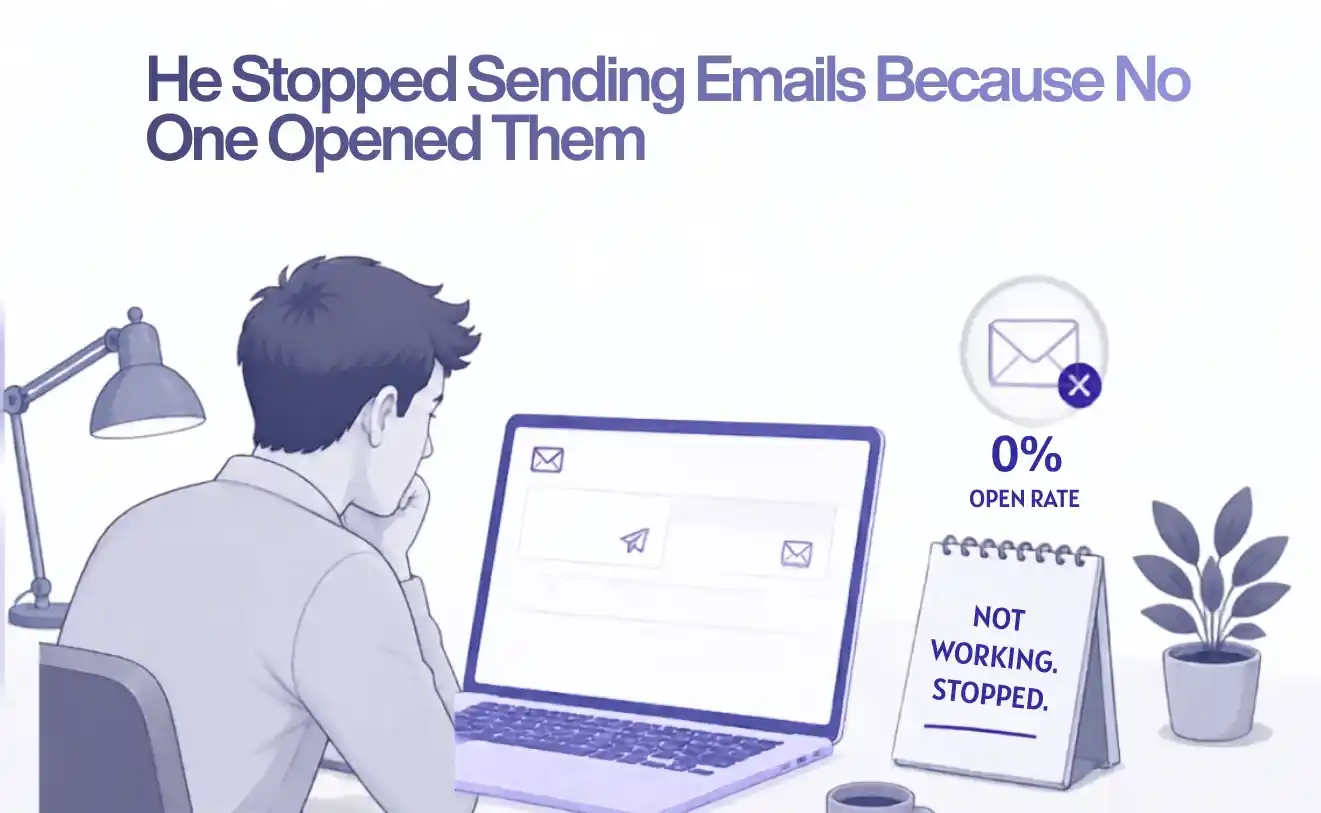
He Stopped Sending Emails Because No One Opened Until One Campaign Brought Back His Old Customers
Email isn’t outdated it’s just misunderstood.
Ankit hovered over the “Send Campaign” button on his laptop in Mumbai, then quietly closed the tab.
“No one reads emails anymore,” he muttered to himself.
Outside his office window, the evening traffic moved slowly through the city. Notifications from Instagram ads kept appearing on his phone. Clicks were coming in. Views were increasing. But sales still felt unpredictable.
He ran a small online gifting business.
Not a massive company. Just a growing brand built through years of effort, customer trust, and word-of-mouth orders.
A year earlier, he had tried email marketing in India for the first time.
He sent festive offers.
Discount announcements.
New product launches.
Flash sales.
But the results disappointed him.
Open rates were low.
Replies were almost non-existent.
Eventually, he convinced himself that email marketing in India no longer worked.
So he stopped completely.
Instead, he shifted all his focus toward social media marketing and paid advertising.
At first, it felt like the smarter move.
Instagram gave him visibility.
Ads brought traffic.
Reels occasionally went viral.
But something still felt incomplete.
That afternoon, while checking old customer records, Ankit noticed something he had ignored for months.
Hundreds of previous buyers.
People who had already trusted his business once.
Customers who had purchased birthday gifts, anniversary hampers, and festive packages from him before.
Yet he wasn’t reaching any of them anymore.
He kept spending money trying to attract new people while forgetting the audience that already knew his brand.
That realization stayed with him the entire evening.
He remembered reading how successful brands still relied heavily on email marketing in India to build customer loyalty and repeat sales instead of depending only on ads.
So before leaving the office, he decided to try one more time.
Just one email.
Not a promotional blast.
Not a discount campaign.
Just a simple message.
That small decision changed more than he expected.
Here’s what many businesses forget: getting a new customer is expensive, but reconnecting with an existing customer is often much easier.
That is exactly why email marketing in India continues to matter in 2026.
While trends keep changing, customer relationships still drive long-term business growth.
And email remains one of the few digital marketing channels where businesses can directly reach people without depending entirely on algorithms.
Is Email Marketing Still Relevant in 2026?
Ankit assumed email had become outdated.
But the reality looked very different.
Email didn’t disappear.
People simply became more selective about what they opened.
That’s the biggest shift.
Years ago, businesses could send generic promotional emails to everyone and still receive decent engagement.
Today, inboxes are crowded.
People receive newsletters, promotional offers, platform notifications, and marketing messages every single day.
So naturally, attention has become limited.
But relevant emails still work remarkably well.
In fact, email marketing in India is growing stronger for brands that focus on connection instead of interruption.
People may ignore random promotions.
But they still open messages that feel useful, personal, or timely.
That’s because email is no longer just a broadcasting tool.
It has become a relationship-building channel.
Unlike social media platforms, email gives businesses direct access to their audience.
There’s no fight against constantly changing algorithms.
No dependence on reach fluctuations.
No fear that followers may never see the content.
Instead, there’s simply a message waiting in someone’s inbox.
And if that message feels relevant, it gets opened.
That direct connection is what still makes email marketing valuable in 2026.
Especially for businesses in India trying to build repeat customers and long-term trust.
Why Email Marketing Still Delivers Strong Results
High ROI Compared to Other Channels
One reason businesses continue investing in email marketing in India is the return on investment.
Social media ads can become expensive very quickly.
Paid campaigns often require continuous spending.
But email campaigns usually cost far less while helping businesses stay connected with existing customers.
For smaller businesses, this matters a lot.
Especially when budgets are limited.
Direct Customer Communication
Social media platforms control visibility.
An algorithm decides who sees your content.
Email works differently.
When someone subscribes or purchases from your business, you already have a direct communication channel.
That changes the relationship completely.
Better Customer Retention
New customer acquisition is important.
But repeat customers are often more profitable.
People who already trust a business are more likely to purchase again.
That’s where email marketing campaigns in India create long-term value.
Not through one viral moment.
But through consistent communication.
Why Most Email Marketing Fails
Later that week, Ankit opened his old email campaigns again.
He immediately noticed a pattern.
Every email sounded almost identical.
“Big Sale!”
“Limited Offer!”
“Buy Now!”
Nothing felt personal.
Nothing felt useful.
There was no emotional connection.
No context.
No reason for someone to stop and care.
That’s why people ignored them.
Most email marketing fails because businesses treat email like a loudspeaker instead of a conversation.
But inboxes don’t work that way anymore.
People are constantly filtering information.
If an email feels generic, it gets skipped immediately.
Sometimes without even being opened.
That’s the challenge modern businesses face.
Not visibility.
Relevance.
Because people don’t open emails simply out of curiosity anymore.
They open emails when the message feels important to them personally.
What Actually Works in Email Marketing Today
Ankit changed his approach completely.
Instead of sending promotional banners and discount-heavy subject lines, he tried something simpler.
Something more human.
His next email said:
“Hey, it’s been a while since your last order. We’ve added some new personalised gift options recently. Want me to show you a few?”
That was it.
No aggressive selling.
or the pressure.
Nor flashy offer.
And surprisingly, people responded.
Few replied directly.
Some asked questions.
Some clicked through and placed new orders.
The difference wasn’t the product.
It was the tone.
The email felt conversational instead of promotional.
And that changed everything.
Because modern email marketing works best when it feels personal.
Not corporate.
Not automated.
Just thoughtful.
“Email works when it feels like a message from someone you trust not a promotion from someone you ignore.”
That single shift is transforming how successful brands approach email marketing in India today.
Why Personalisation Matters More Than Ever
Ankit also started organizing his customer data differently.
Earlier, everyone received the exact same email.
Now he created separate customer groups.
People who purchased recently.
People who hadn’t ordered in months.
Festival shoppers.
Corporate gifting customers.
Each group received different communication.
Relevant communication.
Because relevance drives attention.
And attention drives action.
This is where many businesses still struggle.
They focus too much on sending more emails instead of sending better emails.
But quantity alone doesn’t improve engagement.
Personalisation does.
Even small details can make a huge difference.
Mentioning a previous purchase.
Referring to a festival season.
Suggesting products based on customer interests.
These things make emails feel intentional.
And intentional communication gets noticed.
That’s why personalisation has become one of the biggest success factors in email marketing campaigns in India.
Email Marketing vs Social Media Marketing
Ankit also noticed something else over time.
On social media, he constantly competed for attention.
People scrolled quickly.
Posts disappeared within hours.
Engagement fluctuated unpredictably.
But email felt calmer.
More focused.
When someone opened his email, they were already paying attention.
No endless scrolling.
Neither competing reels.
Nor crowded feed.
Just the message.
That’s the real difference.
Email marketing does not replace social media marketing.
Both serve different purposes.
Social media builds visibility.
Email builds relationships.
Social media helps people discover your business.
Email helps them remember it.
And businesses usually grow faster when both channels work together.
The Long-Term Power of Staying Connected
The biggest impact wasn’t immediate sales.
It was consistency.
Every thoughtful email helped Ankit stay connected with customers.
People remembered his brand again.
So when birthdays, anniversaries, or festivals arrived, customers returned naturally.
Not because of aggressive marketing.
But because the relationship already existed.
That’s the real power of email marketing in 2026.
Not one successful campaign.
Not one high-converting subject line.
But continuous connection over time.
A week after sending that simple email, Ankit checked his dashboard again.
A few new orders had arrived.
Not massive numbers.
But meaningful ones.
More importantly, conversations had restarted.
Replies had started appearing again.
His customers hadn’t disappeared.
He had simply stopped reaching them.
And that realization changed how he viewed marketing completely.
Because sometimes growth doesn’t come from finding new people.
Sometimes it comes from reconnecting with the people who already trusted you once.
If your business already has customers, subscribers, or previous buyers, the real question is this:
Are you staying connected with them or silently disappearing from their attention?
Because even in 2026, email marketing in India is still one of the most powerful ways to stay remembered.
References:
Email marketing new rules