

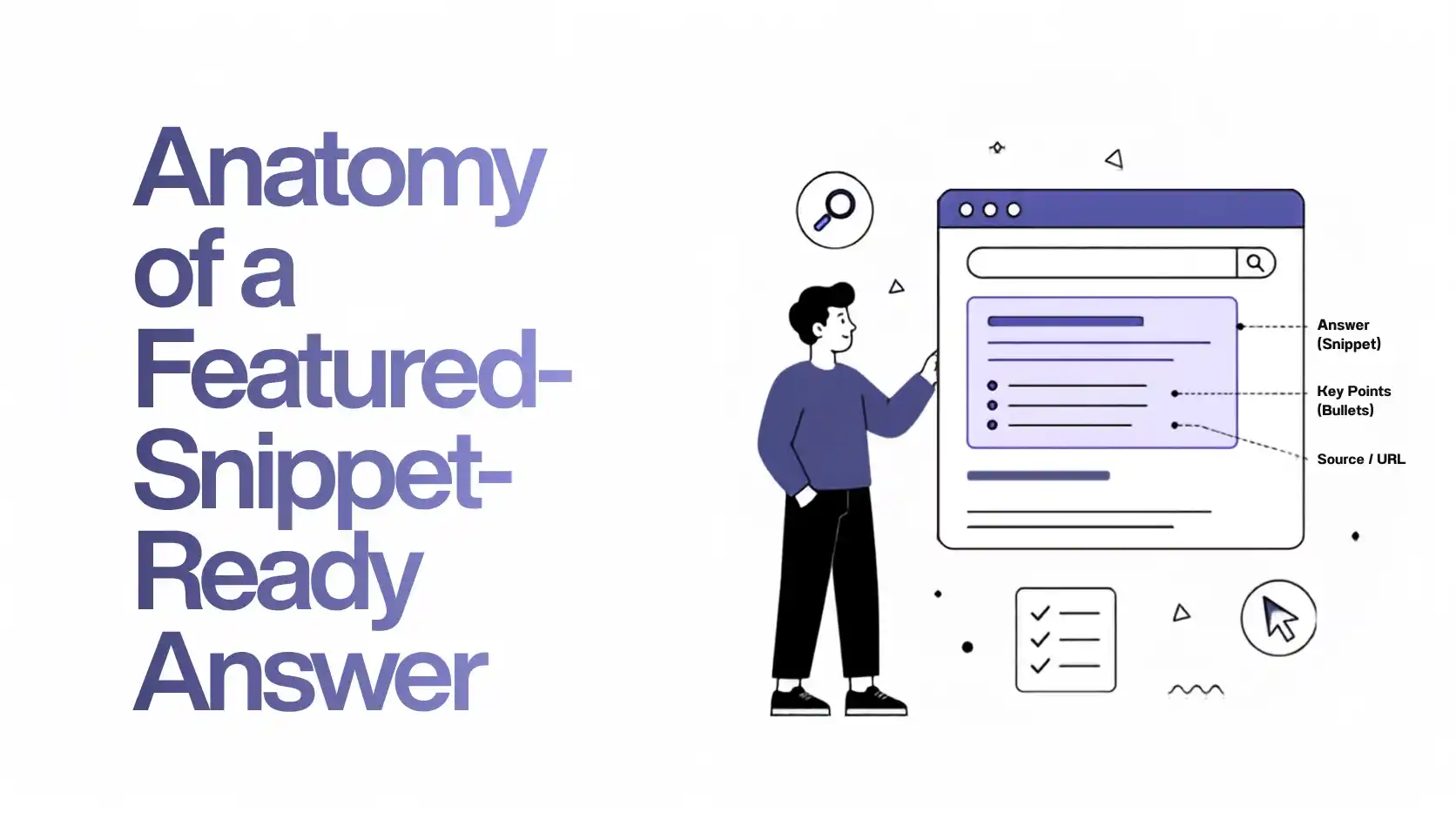
Some pages seem to win Featured snippet optimisation constantly, almost effortlessly, while other pages with equally good information never get pulled into that box at the top of the results. It’s tempting to chalk that up to luck, or to domain authority alone, but that’s not really the full story. Featured snippets follow a fairly consistent structural pattern, and once you see it, you start noticing it everywhere.
Featured snippet optimisation isn’t about writing better content in some vague, general sense. It’s about building a specific, extractable block within your content that Google’s systems can lift out cleanly and confidently. Let’s break down exactly what that block looks like.
Why Some Answers Get Pulled and Others Don’t
Google’s snippet system is looking for a passage that answers a specific query clearly, concisely, and without requiring the reader to piece together information from multiple places. It’s not necessarily choosing the single best page overall. It’s choosing the single best answer block, which sometimes lives on a page that isn’t otherwise the top-ranking result.
That distinction matters. A comprehensive, well-researched article can lose the snippet to a shorter, less authoritative page simply because that page structured its answer more cleanly. The information being right isn’t enough. It has to be presented in a shape Google’s systems can extract with confidence.
The Core Anatomy of a Snippet-Ready Block
Every strong snippet answer shares a few structural traits, regardless of the topic. First, there’s a clear, standalone answer sentence or short passage that directly addresses the question, positioned right after the heading that poses it, not several sentences later.
Second, that answer works without needing the rest of the page for context. If you could copy just that block and paste it somewhere else, and it would still make complete sense to someone with no other information, that’s a strong sign it’s snippet-ready. Answers that lean on “as mentioned above” or reference earlier points in the article tend to get skipped over, since they can’t stand alone.
Third, the format often matches the type of question being asked. A “how to” query pairs well with a numbered list. A comparison question pairs well with a short table. A definition question pairs well with a tight one or two sentence paragraph. Google tends to favor whichever format naturally fits the query type, so mismatching format to intent, like writing a long paragraph for a step-by-step process, hurts your odds even with accurate information.
Matching Format to Query Type
For “what is” and definition-style questions, a concise paragraph answer, roughly forty to sixty words, tends to perform best. Lead with the definition itself in the very first sentence, then follow with a bit of supporting context.
For “how to” and process questions, numbered lists work best, with each step written as a short, clear instruction rather than a dense paragraph. Google often pulls these directly into a numbered snippet format, which means matching that structure yourself increases the odds of a clean extraction.
For comparison and “versus” questions, a short table with clearly labeled columns tends to win out over prose explanations, since it lets Google display the comparison visually rather than trying to extract meaning from a paragraph.
For list-based questions, like “types of X” or “best X for Y,” a bulleted list with brief descriptions per item tends to outperform the same information written as flowing paragraphs.
Building the Question Into Your Heading
Featured snippet optimisation depends heavily on matching your subheading phrasing to how people actually search. A heading like “Understanding the Fundamentals” tells a search engine almost nothing about what question it answers. A heading phrased as “What Is a Featured Snippet Optimisation” makes the connection explicit and immediate.
This doesn’t mean every heading needs to be an exact question. It means the phrasing should closely mirror real search queries rather than clever marketing language that requires inference to connect. When in doubt, check what people are actually typing into Google for that subtopic, and let that shape your heading.
Common Mistakes That Break the Extraction
Answering a question across several paragraphs, without ever consolidating it into one tight passage, is one of the most common ways good content misses a snippet it should otherwise win. Google’s system needs something compact enough to display, not a scattered answer spread across a full section.
Starting an answer with unnecessary preamble, like “this is a great question that many people ask,” wastes the exact space that needs to hold your actual answer. Get to the point in the first sentence.
Using vague or overly qualified language, without ever landing on a direct, confident statement, also works against you. A featured snippet needs something clean and quotable, not a paragraph full of hedges and caveats before finally arriving at an answer.
Testing and Refining Your Snippet Blocks
Featured snippet optimisation isn’t always a one-shot process. If you’ve structured an answer well and still aren’t winning the snippet, check what page currently holds it and compare formats directly. Sometimes the gap is subtle, like their answer being slightly more concise, or their heading matching the query phrasing more precisely than yours does.
It’s also worth revisiting old content that ranks well but has never won a snippet. Often the underlying information is already solid, and the only thing missing is restructuring an existing paragraph into a cleaner, more extractable block near the top of the relevant section.
Reference
The Bottom Line
Featured snippet optimization comes down to building a specific, self-contained answer block that matches both the query’s phrasing and its natural format, whether that’s a short paragraph, a numbered list, or a comparison table. The information doesn’t need to be more comprehensive than your competitors’. It needs to be shaped in a way Google’s systems can lift out cleanly and hand directly to the searcher.
Frequently Asked Questions
Q: What is featured snippet optimization?
A: Featured snippet optimization is the process of structuring content so Google can easily extract and display it at the top of search results. It focuses on providing clear, concise, and self-contained answers that directly match a user’s search query.
Q: How do I optimize my content for a featured snippet?
A: Start by using question-based headings that reflect real search queries, then place a direct answer immediately below each heading. Match the content format to the search intent by using short paragraphs for definitions, numbered lists for processes, tables for comparisons, and bullet lists for collections of items.
Q: Why doesn’t my page win a featured snippet even though it ranks well?
A: Ranking well doesn’t automatically guarantee a featured snippet. Google selects the page with the clearest and most extractable answer, so content that is better structured and easier to display may earn the snippet even if it ranks below your page.
Q: Which content formats are most likely to appear as featured snippets?
A: Google commonly displays featured snippets as short paragraphs, numbered lists, bulleted lists, and comparison tables. Choosing the format that best matches the user’s search intent improves the likelihood of your content being selected.
Q: Should I rewrite older content for featured snippet optimization?
A: Yes. Many existing articles can earn featured snippets by reorganizing information rather than rewriting the entire page. Adding direct answers below relevant headings, shortening long explanations, and improving content structure can significantly increase your chances of being featured.
Q: Is featured snippet optimisation still important with AI-powered search?
A: Absolutely. Featured snippets remain valuable because they improve visibility in traditional Google Search and encourage clear, answer-focused content that also benefits AI search tools. Optimising for featured snippets often supports broader SEO, Answer Engine Optimisation (AEO), and Generative Engine Optimisation (GEO) strategies at the same time.