

Most content checklists are built around old habits. Check your title tag, check your meta description, check your keyword density, done. None of that is wrong exactly, but none of it answers the newer question that actually matters now: would an AI system reading this page have enough clear, trustworthy, well-defined information to confidently cite it?
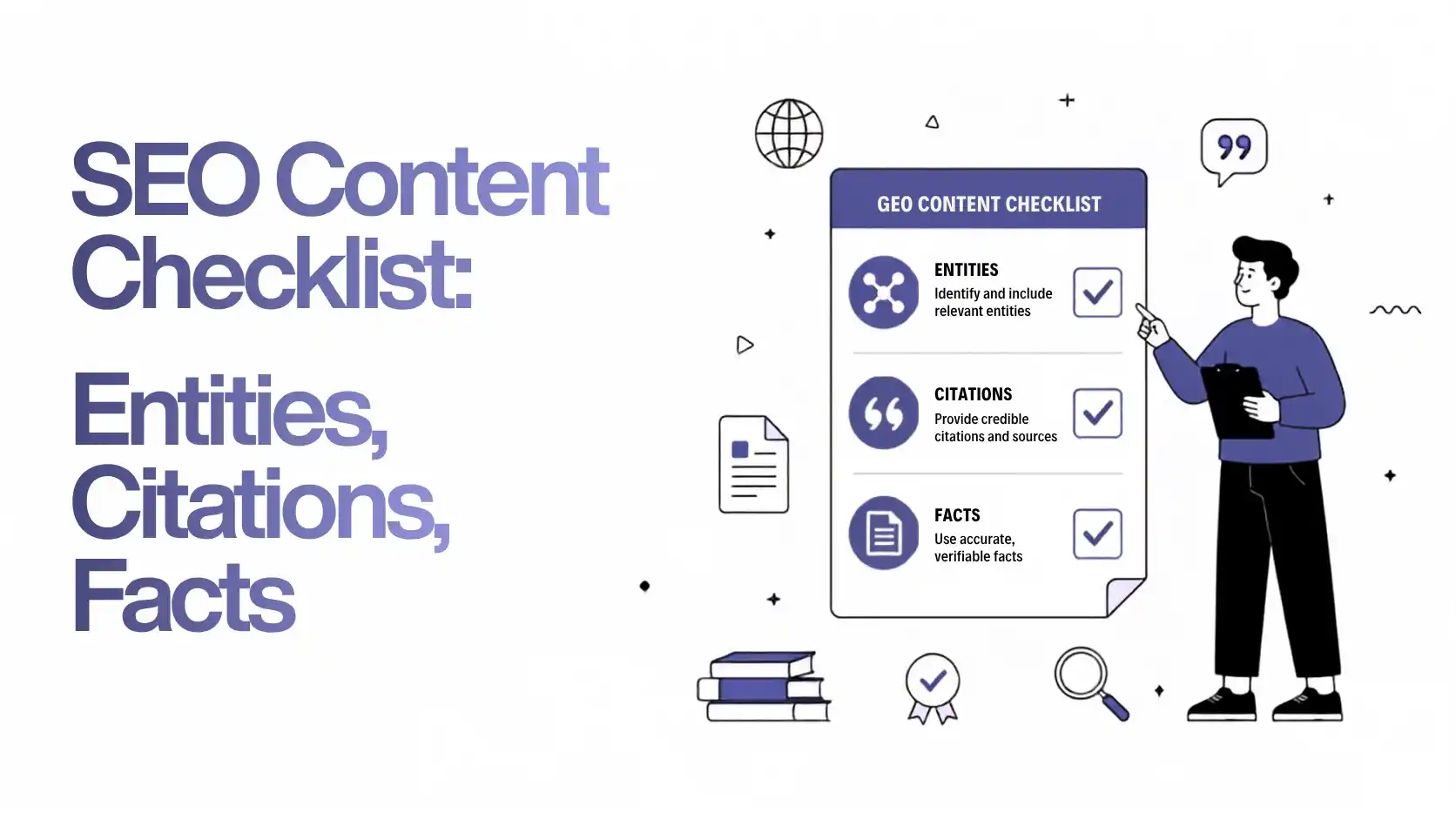
That’s a different kind of checklist, and it’s worth building deliberately rather than bolting a few AI-related tweaks onto your existing SEO process. This GEO content checklist covers the three areas that consistently separate content AI tools cite from content they quietly skip past: entities, citations, and structured facts.
Entities: Making Sure AI Systems Know Who and What You’re Talking About
An entity, in this context, is any clearly identifiable person, organization, product, or concept your content references. AI systems build a kind of internal map of entities and how they relate to each other, and content that clearly identifies its entities is easier for these systems to place confidently within that map.
Start by checking whether your content names things specifically rather than vaguely. “A major search engine” is vague. “Google” is an entity. “A recent update” is vague. “The March 2026 core update” names a specific, identifiable entity an AI system can anchor to.
Make sure your own brand and any people quoted or credited are clearly and consistently named, ideally matching how they’re referenced elsewhere on the web, since consistency helps AI systems connect your content to the same entity elsewhere rather than treating each mention as ambiguous or disconnected.
Link entities to established reference points where it makes sense, mentioning a well-known organization, standard, or concept by its full, recognizable name rather than an abbreviated or informal version that might not clearly map to anything specific.
Citations: Backing Claims With Real, Checkable Sources
This is one of the more overlooked items on a typical GEO content checklist. AI systems weighing whether to trust a claim are more confident citing content that itself demonstrates good sourcing, rather than content that states things as flat assertions with nothing behind them.
Check whether your specific claims, statistics, and data points reference where that information actually came from. A vague statement like “core updates are becoming more frequent” is weaker than one that points to an actual pattern, like the shift from twice-yearly updates to roughly every three months based on 2026’s rollout cadence.
Where you’re citing outside data or research, name the source directly rather than saying “studies show” without any real anchor. This isn’t just good practice for human readers, it gives AI systems a concrete, checkable reference point that strengthens the credibility of the whole passage around it.
Original citations you can offer, your own data, your own testing, your own firsthand experience, carry even more weight here, since they position your content as a primary source rather than a secondary summary of information available elsewhere.
Structured Facts: Making Key Information Extractable
The third pillar of this GEO content checklist is about format, not just content quality. A true fact stated in a confusing, buried, or overly qualified way is far less useful to an AI system than the same fact stated plainly and positioned clearly.
Check whether your key facts and figures are stated as direct, standalone sentences rather than woven into long, complex sentences that also cover several other points at once. A sentence trying to do five things at once makes it harder for an AI system to isolate the one fact worth extracting.
Use lists and tables wherever you’re presenting comparable data points, since these formats make individual facts easy to isolate and reference cleanly. A paragraph describing three different statistics in flowing prose is harder to extract from than the same three statistics presented as a short list.
Add structured data markup, particularly FAQ and HowTo schema where genuinely applicable, so the relationship between a question and its factual answer is explicit rather than something an AI system has to infer from formatting alone.
Putting the Checklist Together
Before publishing or updating a piece, run through it deliberately. Are the key people, organizations, and concepts named specifically rather than vaguely? Are your claims and statistics backed by a named, checkable source rather than left as bare assertions? Are your most important facts stated as clean, standalone sentences, and formatted as lists or tables where that fits the content?
None of these checks require a complete rewrite of your process. Most existing content can be improved significantly just by tightening vague references into named entities, adding a source line to unsupported claims, and pulling buried facts into cleaner, more isolated sentences.
Why This Combination Matters More Than Any Single Item
Entities, citations, and structured facts work together rather than independently. Clear entities help an AI system understand what your content is about. Solid citations help it trust what your content claims. Structured facts help it actually extract and use what your content states. Strong on one but weak on the others still leaves gaps, content that names things clearly but backs nothing up, or that’s well-sourced but too tangled in prose to extract cleanly, both fall short of what this checklist is aiming for.
Reference
The Bottom Line
A proper GEO content checklist isn’t about chasing a new set of keyword tricks. It’s about making sure your content clearly identifies what it’s talking about, backs its claims with real, checkable sources, and states its key facts in a form AI systems can actually extract and trust. Run new content through these three checks before publishing, and revisit older content with the same lens, since even small, targeted edits here tend to make a real difference in whether AI tools choose to cite you at all.
Frequently Asked Questions
Q: What is a GEO content checklist?
A: A GEO content checklist is a framework for creating content that AI search tools can easily understand, trust, and cite. Instead of focusing only on traditional SEO elements like keywords and meta tags, it emphasizes clear entities, credible citations, and well-structured facts that make information easy for AI systems to extract.
Q: Why are entities important for Generative Engine Optimization (GEO)?
A: Entities help AI systems identify exactly who, what, or which organization your content is discussing. Using specific names instead of vague references reduces ambiguity and improves the chances that AI tools correctly understand and reference your content in generated answers.
Q: Do AI search tools prefer content with citations and sources?
A: Yes. Content that supports claims with reliable, named sources is generally viewed as more trustworthy than unsupported statements. Including references to reputable research, official reports, or original data also strengthens your content’s credibility for both readers and AI systems.
Q: How should I structure content so AI can extract key information?
A: Present important facts in clear, standalone sentences and use headings, tables, or lists where they improve readability. Adding structured data such as FAQ or HowTo schema can also help AI systems understand the relationships between questions, answers, and important information on the page.
Q: Can I improve existing content using a GEO content checklist?
A: Absolutely. Many older articles can become more AI-friendly by replacing vague references with specific entities, adding citations to unsupported claims, and reorganizing important facts so they are easier to identify and extract. These updates often require refinement rather than a complete rewrite.
Q: Is a GEO content checklist a replacement for traditional SEO?
A: No. Traditional SEO remains essential for improving search visibility and driving organic traffic. A GEO content checklist complements those efforts by making your content more likely to be cited by AI-powered search tools like ChatGPT, Perplexity, and Gemini, helping your brand gain visibility across both search experiences.