

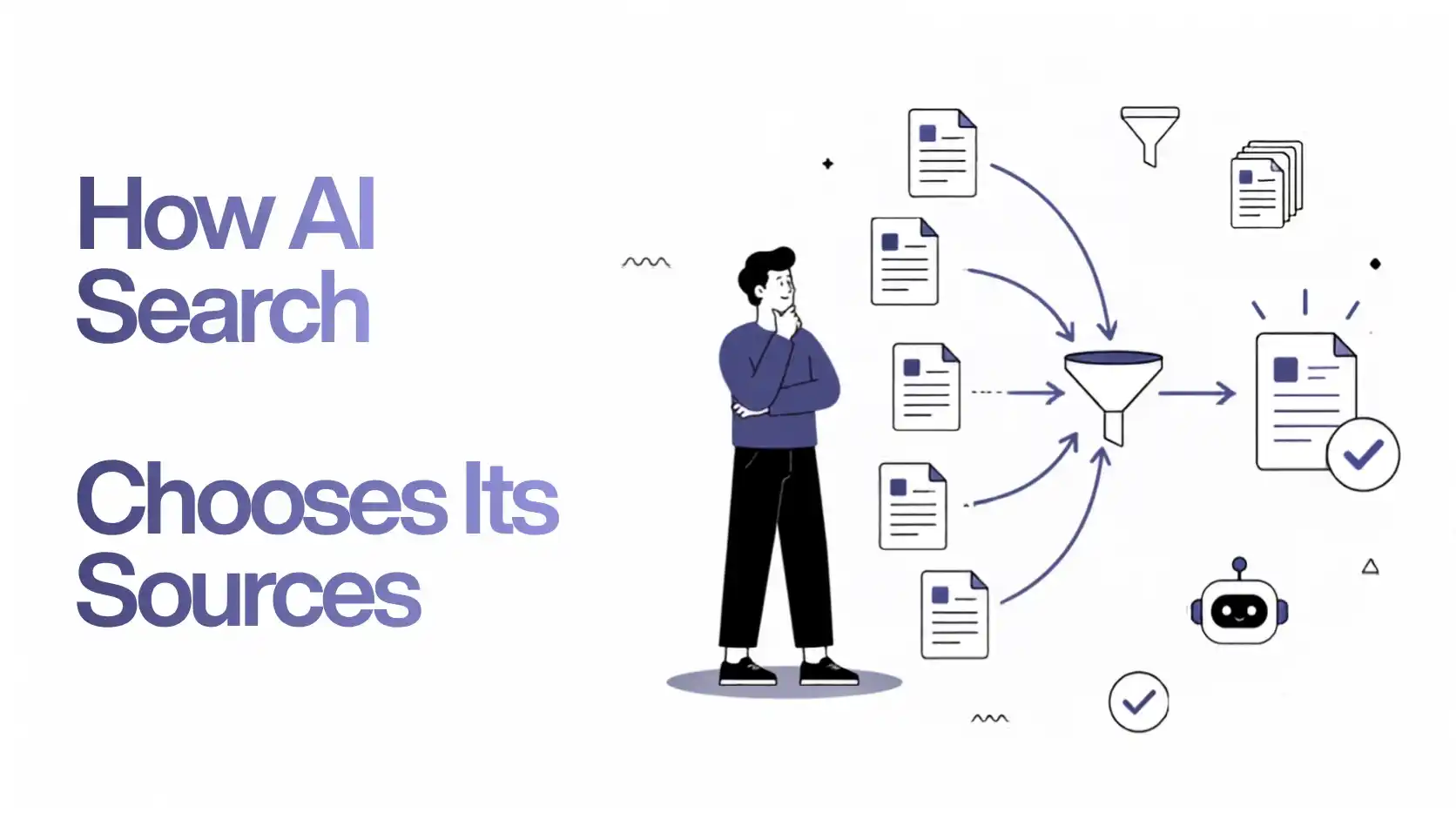
Ask an AI assistant the same question twice, a week apart, and you might get two different sources cited. That inconsistency drives a lot of people crazy, and it’s tempting to conclude the whole process is random. It’s not, though it is genuinely more fluid and layered than traditional search ranking ever was. Understanding how AI chooses sources means understanding several factors working together, not one clean formula you can reverse-engineer in an afternoon.
This isn’t a black box you can’t reason about. It’s a set of signals, some familiar from SEO, some genuinely new, that together determine whether your content ends up as the answer or gets quietly passed over.
Relevance Is the Starting Point, Not the Finish Line
The first filter is straightforward enough: does this content actually address the question being asked. That part isn’t too different from traditional search, and it explains why solid keyword and topical coverage still matters even in an AI-driven landscape. But relevance alone gets you into the consideration set, not the final citation. Plenty of relevant pages exist for any given query, and something else has to separate the ones that get chosen from the ones that don’t.
Clarity and Extractability Narrow the Field
Once a source clears the relevance bar, the next real question is how AI chooses sources among several relevant options, and clarity plays an outsized role here. A page with a direct, self-contained answer near the top of a relevant section is simply easier to lift and use than a page saying the same thing buried across several meandering paragraphs.
This is partly a practical, mechanical filter. These systems are working fast, often synthesizing from multiple sources at once, and a source that hands over a clean, ready-to-use passage requires less processing and interpretation than one that requires piecing an answer together. All else being roughly equal, the clearer source tends to win that competition.
Credibility Signals Carry Real Weight
This is where things diverge more sharply from traditional search. AI systems appear to weigh credibility signals, like clear authorship, demonstrated expertise, accurate and current publication dates, and consistent entity recognition, quite heavily when deciding whether a source is trustworthy enough to cite by name.
An anonymous page with no clear author, no indication of expertise, and outdated information might contain accurate content, but it gives an AI system little basis for confidence in citing it specifically. A page from a source with a track record, clear bylines, and visible expertise gives that system a much easier basis for trust.
Specificity Beats Generic Competence
Here’s a factor that surprises people. Being accurate and well-written isn’t enough on its own if the content doesn’t offer anything beyond what the AI model already knows from its training. If a passage states something so generic that the model could generate an equivalent statement unprompted, there’s less incentive to cite a specific source for it at all.
Specificity changes that calculation. A concrete number, a named example, an original data point, a detail that clearly required real research or firsthand experience to produce, gives the AI system a genuine reason to attribute that information to a source rather than presenting it as general knowledge. This is a big part of how AI chooses sources when several options are otherwise similarly credible and clear: it favors whichever one actually adds something distinct.
Corroboration Across Multiple Sources
Some AI systems, particularly those doing live retrieval like Perplexity, appear to weigh whether multiple credible sources agree on a claim, which can work in your favor or against you depending on how unique your content is. Being one of several sources saying the same accurate thing can actually increase the odds that specific claim gets surfaced, since it reinforces confidence in the information itself.
This means being part of a broader, credible conversation on a topic isn’t necessarily a disadvantage. It’s more that the system is triangulating trust across sources, and your best chance of being the one specifically named still comes back to being the clearest, most specific, most credible version of that shared information.
How to Actually Become a Chosen Source
Start with relevance, making sure your content genuinely and thoroughly addresses the questions your audience is asking, not just adjacent topics. From there, focus on structure, putting direct, self-contained answers where they can be found and extracted easily, rather than requiring an AI system to infer meaning from surrounding context.
Build credibility deliberately. Clear author bios with real expertise, accurate and regularly updated publish dates, and consistent naming of your brand and contributors all feed into whether an AI system treats you as a trustworthy source worth naming rather than a source it paraphrases anonymously.
Add genuine specificity wherever you can. Original research, firsthand testing, concrete numbers and examples, anything that goes beyond what could be generated from general knowledge, gives these systems an actual reason to cite you by name instead of treating your point as common knowledge.
Reference
The Bottom Line
How AI chooses sources comes down to a layered set of signals working together: relevance gets you considered, clarity and structure make extraction easier, credibility builds trust, and specificity gives a system a real reason to name you rather than paraphrase generically. None of these factors work in isolation. The sources that consistently get chosen are usually strong across all four, not exceptional at just one.
Frequently Asked Questions
Q: How does AI choose which sources to cite in its answers?
A: AI systems typically evaluate several signals rather than relying on a single ranking factor. They look for content that is relevant to the user’s question, easy to extract, backed by credible expertise, and detailed enough to add value beyond generic information. Pages that perform well across all of these areas are more likely to be cited.
Q: Why does ChatGPT sometimes cite different sources for the same question?
A: AI-generated responses can change over time because retrieval methods, available sources, and the way information is synthesized are constantly evolving. That doesn’t mean the process is random—it reflects a dynamic evaluation of the most relevant and trustworthy information available at the time of the query.
Q: Does traditional SEO still matter for AI search?
A: Yes. Strong SEO fundamentals such as topical relevance, well-organized content, and search intent alignment remain important because they help AI systems identify relevant pages. However, AI search also places greater emphasis on clarity, credibility, and original insights when deciding which sources to reference.
Q: What makes content more likely to be cited by AI assistants?
A: Content that answers questions directly, demonstrates real expertise, and includes original examples, research, or data has a stronger chance of being cited. AI systems tend to favor information that is easy to understand and offers something more valuable than a generic summary.
Q: Do author expertise and credibility affect AI source selection?
A: Yes. Clear author bylines, evidence of subject matter expertise, accurate publication dates, and consistent brand information all help establish trust. These credibility signals make it easier for AI systems to determine whether your content is reliable enough to reference in generated responses.
Q: How can businesses improve their chances of becoming an AI-cited source?
A: Focus on answering customer questions thoroughly, structure your content so key information is easy to find, and support your claims with original research or real-world experience. Regularly updating content and maintaining strong credibility signals can also improve your chances of being cited across AI platforms like ChatGPT, Perplexity, and Gemini.